Showing posts with label Endemic birds. Show all posts

Monday, November 8, 2010

FOGSL Field Trip to Peak Wilderness

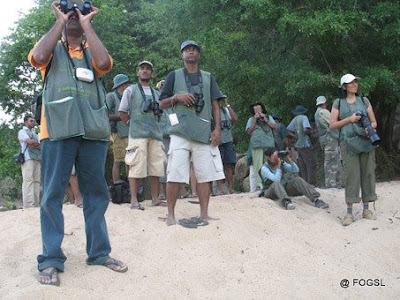
On a warm, sunny day, on 22nd October, peaceful and calm Eratne lay before us, twelve members comprising veterans and novices of FOGSL who were to enjoy two days in Peak Wilderness. Adawikanda was our last stop before the long climb to our abode; Seetha Gangula nawathanpola began by foot.


Peak Wilderness nestles in the centre of the Western ridge of the Central Highlands, north-east of Ratnapura. The wilderness also stretches towards the borders between Central and Sabaragamuwa provinces. With the abundance of treasures and mysteries, Peak Wilderness has been classified as the most constantly wet part of Asia, West of Borneo.


Our slow and tedious walk lasted for about 4 1/2 hours. In spite of the fatigue, we were in awe of the surroundings. We had lunch near a site where a dam was built, to make use of waters of a cascading waterfall to generate electricity to the villagers as well as the national grid. Cool winds and water, replenished us for awhile. Back on the route, we increased our pace, knowing we had to reach our destination before nightfall.


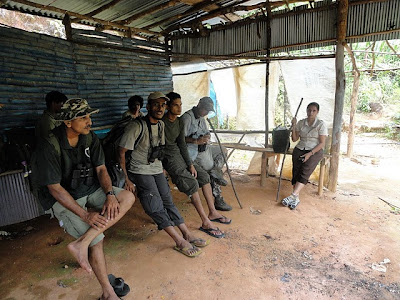
The valley spread before us, as we climbed higher. Through trees and shrubs we could get a peek at the vast expanse of greenery beyond. After walking, stumbling and panting along the distance, we spotted the Ambalama with relief. The waters of Seethagangula beckoned us quietly. Tents were put up, by the able men while Mahatun Mama, a faithful guide and friend of members of FOG for the past 5 years, along with his aides, Bandara and another, got the hearth going for the preparation of tea and dinner.

The only females in the herd, Komila and I hurried to the river to take a wash before it grew too dark. While we attempted to hide behind a rock for privacy, we later heard that a troupe of monkeys had apparently been watching us from a tree!


Morning dawned on the 23rd, after a terribly cold night. The few Buddhists in the group were hoping to climb Shri Pada. After much thought, I decided to join the 7 members to climb the rock. We began the long journey around 6.00 a.m. Four members stayed back to go birding in the surroundings adjacent to the Ambalama.


Legs aching, panting madly, slipping and struggling we trekked for about 1 1/2 hours before stopping over for a breakfast of ‘Kadala’ and coconut at a dilapidated ambalama, which during the season, would have been thriving with free meals and hot cups of tea for pilgrims.

The long trek began again with us being determined to spot a few birds to add to the list! It was treat, therefore, to see a Legg’s flower pecker having its own breakfast, feeding on some small fruit. A pair of Nuthatches was making a racket on a tree, presumably pecking away at some insects they had scented and spotted. We saw yellow eared bulbuls, hill mynahs and red vented bulbuls chirping away, on that glorious morning. The air was fresh and pure, and the sun shone bright and hot on us.


“Start climbing early, try to make it to the summit before 1.00 p.m. If you can’t and even if the summit is just there to reach, you need to climb down looking at it, by 1.30 p.m and reach the ambalama by 6.00 p.m.” were the instructions we got from Dr. Newton Jayawardane and Chaminda Jayaratne. We knew we had to keep to the deadlines and we were chasing time! There were traces of Elephant dung as we passed ‘batakelle’. A few blood thirsty leeches were making an effort to get on us, and some succeeded in making us bleed a fraction.


We reached the summit around 12.45 p.m. and the experience was awesome! Below, the montane forest cover spread. Vast, pure untouched and spellbinding, the canopy was an umbrella amidst the clouds. We could see the Blue waters of Castlereigh and Mousakelle Reservoirs, and of course the winding path we took was also visible, making us aware of the long trek back on the same route. It was hot and sunny up there. The winds fanned us. After prayers, and a steaming cup of tea given to us by the security officers at the summit, we began our descend. It was disheartening to see volumes of polythene carelessly strewn down the slopes of the summit. Pollution, a burning matter of concern where ever we happened to go, was not strange even to Peak Wilderness. We collected as much garbage as we could, and burnt them all at Galwangediye Kade Ambalama.

Descending was tedious as climbing was. After lunch at Ahala Kanuwa Ambalama, we began a steady descend making sure to pass Batakelle, before 3.30 p.m. We had to avoid elephants incase we ran into them! A prayer to see the Dollar bird was not answered. However, there were species of yellow eared, and black capped bull bulls which greeted us on the way down. Mahatun Mama, bare footed, chirpy and agile, guided us through out this tedious and exhilarating journey.


We reached our Ambalama by 6.05 p.m., much to our delight and probably to the relief of the others who would have been waiting for us. After the check list was done, and dinner taken, we retired to our respective tents, to get whatever sleep we could before returning to base, Adawikanda the next morning. Back at Adawikanda the following afternoon, everyone waited to have a dip in the river. Bandara welcomed us to his humble home, to give us a delicious meal for lunch. We relished the waldel kos ata curry, a novelty and a rare meal for city dwellers.


A few of us had to bid farewell to the group at Avissawella because we were Kandy bound. Back at home; to reminisce and re-live moments, it was a journey worth, making the effort of going! An important learning outcome was, to stay fit and healthy. Life becomes easier when one is in good health!


Bird List

Sri Lanka Jungle fowl
Great Tit
Sri Lanka yellow fronted barbet
Black Crested Bulbull
SriLanka grey hornbill
Red Vented Bulbul
White throated Kingfisher
SriLanka Yellow eared bulbul
Blue tailed bee-eater
Black bulbul
Sri Lanka Hanging Parrot
Yellow browed bulbul
Indian Swiftlet
Sri Lanka White eye
Spotted Dove
Oriental White eye
Emerald Dove
Greenish Warbler
Green Imperial Pigeon
Large billed leaf warbler
Crested Serpent Eagle
SriLanka Brown capped Babbler
Shikra
SriLanka Schimiter Babbler
Brown Shrike
Dark Fronted Babbler
Sri Lanka Blue Magpie
Sri Lanka Orange Billed Babbler
Black Hooded Oriole
Yellow Billed Babbler
Scarlet Minivet
Thick Billed Flower Pecker
Bar winged Flycatcher shrike
Sri lanka Legge’s Flower Pecker
White bellied Drongo
Pale Billed Flower pecker
Crested Drongo
Purple rumped sunbird
Black Naped Monarch
Grey Wagtail
Asian Paradise Flycatcher
White Rumped Munia
Common Iora
Sri Lanka Spot winged Thrush
Asian Brown Flycatcher
Brown breasted flycatcher
Sri Lanka Dull Blue Flycatcher
Tickell’s Blue Flycatcher
Grey Headed Canary Flycatcher
Sri Lanka Myna
Hill Myna
Velvet Fronted Nuthatch


List of Participants:

Mr. Chaminda Jayaratne, Dr. Newton Jaywardena, Ms. Sulakmi Weragama, Mr. Rohan Kaththiriarachchi, Ms. Komila Stanislaus, Mr. Ruwan, Mr. Ranjith Fernando, Mr. Chana, Mr. Nashad Hafi, Mr. Faris, Mr. Amudhesh

Bird list and Report: Sulekshmi Weragama
Photos: Sulekshmi Weragama, Rohan Kaththiriarachchi and Chaminda Jayaratne

To see more Photos

Thursday, October 28, 2010

How we watched birds during the non-migratory period 2010

Enthusiastic bird watchers of ‘Sri Lanka Birds’ community, do not abandon the habit of birding even during the non-migratory period. Since, Sri Lanka facilitate a rich diversity of avifauna, hobby of birding never becomes boring. ‘Sri Lanka Birds’, the community centered database on birds, shows how our bird watchers recorded their observations during the period. Following results are based on the data downloaded on 18th October 2010 for the period from April to September this year.

A total of 59 people who are keen on birds joined with ‘Sri Lanka Birds’ community. FOGSL warmly welcomes our new members and invites them to enjoy the world of birding while contributing to the conservation process of Sri Lankan birds.

Observations (from 1st April to 30th September)
Number of visits (347)
Total Number of Observations (7357)
Number of Species (221)
Number of Endemic Species (21)
Number of Proposed endemic Species (7)
Number of migrant species (32)

Records of Black-necked Stork, Blue-eared Kingfisher and Spot-billed duck are noteworthy observations done during the period. A total of 32 migratory species were recorded, mainly during April and September, which are the endpoints of the season.

Number of nesting observations recorded during the said period was 87. Altogether 44 species were recorded as nesting during the six month interval.


Mostly recorded species (No: of observations)
House Crow (271)
Red-vented Bulbul (253)
Common Myna (248)
White-throated Kingfisher (247)
Spotted Dove (227)

Top five users (No: of observations)
Newton Jayawardane (3843)
Nadika Hapuarachchi (1054)
Amila Sumanapala (791)
Rahula Perera (537)
Chandanie Wanigatunge (496)

Number of locations visited during the period was 107. It covers wide variety of habitats and geographic regions of the island. Most importantly, many visits were from the North and Eastern provinces, which were previously inaccessible to birdwatchers. Thanks to member Newton Jayawardane’s untiring effort to monitor birds in his hometown, the highest number of observations was recorded at Ragama (2744).

Every birdwatcher in the tropical areas is anticipating the migratory season. So it is already started. Time to go out and record birds as much as possible. And while enjoying the world of birds, you can contribute to the conservation of Sri Lankan birds by submitting your data, to the ‘Sri Lanka Birds’ database.

To see current statistics on the number of field visits, number of observations and bird species, as well as the number of users registered in the system, visit the login page of ‘Sri Lanka Birds’.

Thursday, September 16, 2010

FOGSL Annual Workshop on the Bird Flocks of Sinharaja

Mixed species feeding flocks of birds are one of the major highlights of the Sinharaja National Heritage Wilderness Area (SNHWA) as they provide sound to otherwise silent forest and also because most of the birds that one desires to see are found in them. So far 59 bird species (out of 144 found in SNHWA), including 19 endemics have been recorded to form flocks. The two most frequent species observed in these flocks are the Orange-billed Babbler and the Greater-crested Drongo.


Each year FOGSL organizes a field workshop for its members at SNHWA with the objective of providing an opportunity to understand the function and structure of mixed species feeding flocks. This year’s workshop was held from 10-12th September 2010.

We left the University of Colombo on the 9th around seven at night and reached Kudawa at 11.15pm. Thankfully Martin was waiting with his pickup for the luggage, and few of us also managed to get a lift to his lodge where we were stationed for the next three days. Wake up call on the 10th was at 5.30 am and by then the colourful Sri Lanka Magpies were already making noises from nearby trees. We took an early morning short walk to stretch our legs and after a good breakfast entered the protective zone of the forest for serious bird watching. Thirty three bird species were recorded during that day and several bird flock formations were also observed. Species such as Ashy-headed Laughingthrush, Sri Lanka White-faced Starling, Black-naped Monarch, Indian Scimitar Babbler, Malabar Trogon together with the Orange-billed Babbler and the Great Crested Drongo were some of the common species observed in association with these flocks. The highlight of the day was observing a Besra that was perched on a tree stalk. After dinner Martin gave a talk on the history of Sinharaja. He was born in a nearby village and in 1958 moved to his present home, which borders the forest and since then has been involved in activities going within the forest. He spoke about the Government’s selective logging initiatives in the early 1970s and thereafter how the forest became a strictly protected in the late 1980s. Further he mentioned about his observations on the receding water levels of the surrounding streams during the past few decades.

Next day we had a very close encounter with two Sri Lanka Magpies, who came and perched on the wooden beams of the dining hall of the lodge. During our morning walk, the adventurous and young at heart decided to climb Mulawella while the rest opted to go in search for day roosting sites of owls. The scenery form the top of Mulawella was worth the strenuous climb, while on the journey various amphibians, lizards, butterflies and fish were observed. We encountered a large bird flock on the way down. Back on the road, we had an interesting observation where a Spot-winged thrush was attacking a Sri Lanka Magpie. The owl searches were very lucky and had close sighting of the Serendib Scops-Owl and the Chestnut-backed Owlet, both endemic to Sri Lanka. Later, we listen to an interesting lecturer given by Prof. Kotagama on Bird Flocks of Sinharaja as well as the milestone happening towards conserving the forest.


At the very start of day three, a Grey Hornbill was observed near to the lodge and during our walk to the research station several bird flocks were encountered, and tagging behind one flock were two giant squirrels. On our way back, we had a rare opportunity of seeing an Oak Leaf butterfly that repeatedly closed and opened its wings to show us its splendor. After the lunch we returned to Colombo with lots of good memories of birds and other animals as well as shared laughter!


Sinharaja is Sri Lanka’s last large viable area of the virgin primary tropical rainforest which used to cover most of the island in the long gone past. 64% of its trees are endemic and many of them are rare. The reserve is also home to 23% of Sri Lanka’s endemic animals, including 85% of the country’s endemic birds and over 50% of its endemic mammals, reptiles and butterflies.


Participants
Mr. Dinu Ranasinha, Mr. Tharindu Gunaratne, Mr. Asitha Samarawickrama, Ms. Sulakmi Weragama, Ms. Lakshini Bambaradeniya, Mr. Rohan Kaththiriarachchi, Ms. Komila Stanislaus, Mr. Shivarumar Selvaraj, Ms. Devika Gunawardena, Mr. Nilantha Megasuriya, Mr. P.D.R.C. Karunanayake, Mr. Sethiya N. Perera, Mr. Helaranga P. Perera, Mr. K.K.D.L. Ruvinka, Mr. G.D. Illeperuma, Mr. S.K.K. Suraweera, Mr. Ranathunga Chathuranga, Ms. Amaley Munasinghe, Ms. Nishanthi Perera, Mr. D.S. Perera, Mr. Saman Abesingha, Ms. Sindy de Silva, Mr. Amila Salgado, Mr. Kusum Fernando, Mr. Indrika Pradeepa, Mr. Ravindra , Prof. S.W. Kotagama

Bird list: Indrika Pradeepa
Photos and Report: Nishanthi Perera

Birds List
Sri Lanka Spurfowl (h)
Sri Lanka Junglefowl
Crested Serpent-eagle
Besra
White-breasted Waterhen
Emerald Dove
Green Imperial-pigeon
Sri Lanka Hanging-parrot
Sri Lanka Emerald-collared Parakeet
Sri Lanka Red-faced Malkoha
Greater Coucal
Sri Lanka Green-billed Coucal (h)
Sri Lanka Serendib Scops-owl
Sri Lanka Chestnut-backed Owlet
Frogmouth (h)
Indian Swiftlet
Malabar Trogon
White-throated Kingfisher
Sri Lanka Grey Hornbill
Brown-headed Barbet
Sri Lanka Yellow-fronted Barbet
Lesser Yellownape
Black-rumped Flameback
Greater Flameback
Scarlet Minivet
White-bellied Drongo
Greater Racket-tailed Drongo
Black-naped Monarch
Sri Lanka Magpie
Black-crested Bulbul
Red-vented Bulbul
Yellow-browed Bulbul
Sri Lanka Scimitar-babbler
Dark-fronted Babbler
Sri Lanka Orange-billed Babbler
Sri Lanka Ashy-headed Laughingthrush
Sri Lanka White-eye
Velvet-fronted Nuthatch
Sri Lanka Myna
Sri Lanka White-faced Starling
Sri Lanka Spot-winged Thrush
Sri Lanka Scaly Thrush
Golden-fronted Leafbird
Sri Lanka White-throated Flowerpecker
Pale-billed Flowerpecker
Purple-rumped Sunbird
White-rumped Munia

Saturday, July 10, 2010

Birding at Horton Plains National Park and the Hakgala Botanical Gardens


The annual field trip to the hill country for the year 2010 organized by the Field Ornithology Group of Sri Lanka (FOGSL) took place from 25-27th of June with the participation of 18 members. It provided unique opportunity for us to spend two nights in the dormitory at Horton Plains National Park (HNP) and experience the “watershed effect” of the place to its maximum. Horton Plains, a gently undulating highland plateau lying at 2,100m at the south end of the central highlands is the birth place of tributaries of three major rivers of Sri Lanka, namely the Mahaweli, Kelani and Walawe, as the grasslands act as a sponge in storing rain water. The South-West monsoons bring ample rainfall to the area, and the day we arrived was governed by very strong gusty winds, rain and fog. The visibility was very low as most of the time thick mist seeped in and out. Although it was not a good day for birding, we were fortunate enough to spot two Eurasian Blackbirds and a Grey-headed Canary-flycatcher during the evening hours just outside the dormitory.

The next morning we had a closer encounter a Sambur, which is known as the “beggar” right outside our dormitory. This particular Sambur is quite tame and now habituated to humans and likes to steal or beg a meal from the occupants of the dormitory. After photographing the sambur in all angles, we set off to the Arrenga Pool in order to catch a glimpse of the rare endemic Sri Lanka Whistling Thrush or the Arrenga. Even though it is an extremely shy bird our group had high hopes of seeing one. But, the thick mist kept the bird hidden and we only heard its call. Although we were disappointed at not being able to see the Arrenga, we were thankful to the weather gods as we started our hike to Baker’s falls and Worlds End. Blue skies appeared above us and we immensely enjoyed the panoramic views of the mountain ranges covered with patana grasslands and cloud forests. The bright red flowers of the Rhododendron trees added colour to the scenery even though concerns have been expressed about the rapid spread of this plant.

There was never a dull moment on the long trek to Baker’s falls as we were always on the look-out for birds. Seeing Baker’s falls cascading down was indeed worth the long trek. After the trek to Baker’s falls we all stopped to catch our breath and to re-hydrate ourselves. As we were tucking into some biscuits we were able to spot a very cute Dusky-striped Squirrel foraging on the ground.

On our way to World’s end, Chaminda our guide, who is blessed with very sharp eyes, spotted three Greater Flamebacks, a species of woodpecker which is also a proposed endemic bird on the trunk of a dead tree. All of us had a great opportunity to observe them through binoculars. When we reached the top of World’s end we were greeted with a clear view of the surrounding areas as all the mist had cleared. We were able to identify many distinctive land marks including the reservoirs, roads and buildings located far below us.

After world’s end and mini world’s end were both ticked off from our things-to-do list, we all had a welcome lunch as well as a rest before walking along the Dayagama road searching for more birds. We managed to spot a species of snake called the Boie’s Rough-side, known commonly as the “Le Medilla” in Sinhala along the path. The adventurous and enthusiastic went after a bird flock into the forest where species such as Orange-billed Babbler, Great Tit and Velvet-fronted Nuthatch were sighted. We were extremely lucky to see a wild boar close to our vehicle when we were returning to our dormitory after our walk.

All of the highland endemics as well as several rare migrants such as the Kashmir Flycatcher are found at Horton Plains and the area has been identified as an Important Bird Area of the country. The most suitable season for birding is from September to April. Other than birds, the most prominent animal of Horton Plains is the Sambur. Presently there are over 2,000 individuals within the 3,160 hectares, a fairly high number for a single species of herbivore. It has been suggested that the growth of the Sambur population might be triggered by the introduction of new grass species (e.g. Pennisetum glabrum) and the lack of predators, the only predator being the leopard with around 15 recorded individuals.

Many people flock to Horton Plains just to see World’s End and therefore sadly many miss the point of enjoying and protecting the unique biodiversity Horton Plains has to offer! Removal of plants and flowers, drunken behaviour, lighting of fires, littering, harassment of fellow visitors and noise pollution are some of the major problems associated with tourism. It is highly vital to educate visitors to Horton Plains before they are allowed to enter into this important watershed and a true laboratory of nature.

Our wake up call on the 27th was 4.30 a.m. as we left Horton Plains to Hakgala Botanical Gardens at 5.30 sharp to evade the large crowds that invade the gardens during weekends. Our arrival was greeted by a slight drizzle and a Sri Lanka Dull-blue Flycatcher who was enjoying picking insects near a pond. The highlight at Hakgala was the close encounter with a Brown Fish-owl.

We left Hakgala and breakfasted on the windy shores of Gregory Lake in Nuwara Eliya before returning to Colombo.

The nights were certainly cold and we would all have preferred another day at Horton Plains but the birds, animals and friendly people who joined us on this once in a lifetime trip more than made up for it.

Reported by: Asitha Samarawickrama and Nishanthi Perera
Photos and Bird list: Indrika Pradeepa

Participants: Sanjeewa Udawatta, Chaminda Jayaratna, Nishanthi Perera, Ranjith Perera, Mohamad Faris, Asitha Samarawickrama, Janaka Disanayaka, Wernon Fernando, Sulakshi Weragama, Lakshini Bambaradeniya, Rohan Kaththiriarachchi, C.R.I. Gomez, Shamila Perera, Sindy de Silva, Asoka Jayasekara, Malaka Rodrigo, Indrika Pradeepa, Chaminda Mahanayaka


Bird species recorded
Sri Lanka Spurfowl
Sri Lanka Junglefowl
Indian Pond-heron
Crested Serpent-eagle
Rock Pigeon
Sri Lanka Wood-pigeon
Spotted Dove
Sri Lanka Hanging-parrot
Brown Fish-owl
Alpine Swift
White-throated Kingfisher
Yellow-fronted Barbet
Greater Flameback
Scarlet Minivet
Bar-winged Flycatcher-shrike
Jungle Crow
Great Tit
Jerdon's Bushlark
Zitting Cisticola
Black-crested Bulbul
Red-vented Bulbul
Yellow-eared Bulbul
Asian Black Bulbul
Common Tailorbird
Sri Lanka Bush-warbler
Brown-capped Babbler
Sri Lanka Scimitar-babbler
Dark-fronted Babbler
Orange-billed Babbler
Sri Lanka White-eye
Oriental White-eye
Velvet-fronted Nuthatch
Common Myna
Eurasian Blackbird
Oriental Magpie-robin
Pied Bushchat
Dull-blue Flycatcher
Tickell's Blue-flycatcher
Grey-headed Canary-flycatcher
Pale-billed Flowerpecker
Long-billed Sunbird
House Sparrow
Black-throated Munia
Scaly-breasted Munia
Tricoloured Munia
Paddyfield Pipit

Monday, April 19, 2010

Bird watching during the first quarter of the year 2010

Bird watchers, who do it as a hobby, can also participate in conservation programmes. ‘Sri Lanka Birds’ is such a ‘citizen science programme’. Through this initiative, data provided by bird watchers are taken into consideration for the conservation efforts, not only in Sri Lanka, but also in global level.

After nearly two years and four months from the launch of the ‘Sri Lanka Birds’ database, number of observations recorded in the system reached 60,000 while number of visits arrived at 3000. Summary results of the analysis for the first quarter of the year 2010 are given in this report. This analysis is based on the data downloaded on 16th April 2010.

Membership
New members (70)
Total members (453)
FOGSL warmly welcomes new members to the ‘Sri Lanka Birds’ community.

Observations
Number of visits (317)
Total Number of Observations (7240)
Number of Species (288)
Number of Endemic Species (25)
Number of Proposed endemic Species (7)
Number of migrant species (84)

Rare migrant species; White-headed stilt, Brown Noddy, European Bee-eater, Pied avocet, Blyth’s Pipit, Northern Shoveler, and vagrants; Ruddy Shelduck and Southern Grey Shrike, were among the noteworthy observations recorded during the three months period.

Nesting records
Number of observations (44)
Number of species (20)

Species - Asian Palm-swift, Bar-winged Flycatcher-shrike, Baya Weaver, Brown Hawk -owl, Brown-headed Barbet, Common Tailorbird, Coppersmith Barbet, Long-billed Sunbird, Oriental Magpie Robin, Pheasant-tailed Jacana, Pied Kingfisher, Purple Swamphen, Purple-rumped Sunbird, Red-vented Bulbul, Rose-ringed Parakeet, Scaly-breasted Munia, Streaked Weaver, White-bellied Drongo, White-bellied Sea-eagle, Yellow-eyed Babbler

Mostly recorded species (No: of observations)
Red-vented Bulbul (184)
Common Myna (184)
House Crow (181)
Blue-tailed Bee-eater (167)
Yellow-billed Babbler (160)
White-throated Kingfisher (160)

Top five users (No: of observations)
Newton Jayawardane (2186)
Nadika Hapuarachchi (1131)
Ivan Maggini (705)
Amila Sumanapala (704)
Chaminda Jayarathna (674)

A total of 119 locations were visited during the period by ‘Sri Lanka Birds’ members. Highest number of observations was made at Ragama (1481) as in many previous months. Birding locations which were visited during the period showed wide range, including many sites in the Northern and Eastern provinces.

To see current statistics that describe the number of field visits, number of observations and bird species, as well as the number of users registered in the system, visit the login page of ‘Sri Lanka Birds’ .

Saturday, January 23, 2010

Bird watching during the Christmas period - December 2009

Sri Lanka Birds’, Sri Lankan section of the global effort of bird conservation named ‘Worldbirds’ completed highly successful month by the end of December 2009. Number of observations recorded in the system reached 50,000; marking an important landmark during this month. Summary results of the analysis for December 2009 are given in this report. This analysis is based on the data downloaded on 17th January 2010.

Membership
New members (21)
Total members (407)
FOGSL warmly welcomes new members to the ‘Sri Lanka Birds’ community.

Observations
Number of visits (151)
Total Number of Observations (3331)
Number of Species (234)
Number of Endemic Species (21)
Number of Proposed endemic Species (7)
Number of migrant species (55)

Total number of observations, number of species, and number of migrant species recorded for the month marked the highest values so far.

Bar-tailed Godwits recorded at Giant’s Tank and Vankalai National park were noteworthy observations recorded during the month.

Nesting records
Number of observations (17)
Number of species (13)

Species - Baya Weaver, Brahminy Kite, Shikra, White-bellied Sea-eagle, Brown-headed Barbet, Crimson-fronted Barbet, Common Myna, Dark-fronted Babbler, House Crow, White-browed Fantail, Purple-rumped Sunbird, Red-vented Bulbul, and Sri Lanka Scaly Thrush.

Mostly recorded species (No: of observations)
Red-vented Bulbul (109)
Yellow-billed Babbler (88)
Common Myna (88)
White-throated Kingfisher (84)
House Crow (84)

Top five users (No: of observations)
Newton Jayawardane (980)
Chandanie Wanigatunge (733)
Nadika Hapuarachchi (546)
Rahula Perera (224)
Nishantha Ganeshapriya (205)

A total of 84 locations were visited during December by ‘Sri Lanka Birds’ members. Highest number of observations was made at Ragama (560) as in many previous months. It is important to note that some of the locations of North and Eastern provinces were also visited by the members during the month.

Current statistics describing the number of field visits, number of observations and bird species, as well as the number of users registered in the system, are displayed on the login page of ‘Sri Lanka Birds’ .

FOGSL highly appreciates the contributions of members towards conservation of birds through this initiative.

Wednesday, December 23, 2009

November 2009 – Most successful month for bird watching

FOGSL’s citizen science programme for bird conservation - ‘Sri Lanka Birds’, completed its most successful month by the end of November 2009. A short summary of the results obtained during the month of November is given in this brief report. This analysis is based on the data downloaded on 21st December 2009.

Membership
New members - 15
Total members - 385
FOGSL warmly welcomes new members to the ‘Sri Lanka Birds’ community.

Observations
Total Number of Observations - 2883
Number of Species - 226
Number of Endemic Species - 22
Number of Proposed endemic Species - 7
Number of migrant species - 52

Highest number of observations for a month was recorded during November 2009. Number of species recorded during the month was the highest number recorded too. Maximum number of migrants was also recorded during this month. Brown Noddy and Sooty Tern at Gorapadu, Kalpitiya Sandwitch Tern at Keerimundel, Kalpitiya and Bar-tailed godwits at Gorapadu, Giant’s tank and Mannar were noteworthy observations recorded during the month.

Nesting records
Number of observations - 6
Number of species - 2
Purple-rumped Sunbird and Red-wattled Lapwing were the species observed with nesting activities. Brahminy Kite and Indian Robin were recorded in breeding stages other than nesting.

Mostly recorded species (No: of observations)
Blue-tailed Bee-eater (71)
Red-vented Bulbul (55)
House Crow (55)
Yellow-billed Babbler (53)
Rose-ringed Parakeet (46)

Top five users (No: of observations)
Newton Jayawardane (705)
Nadika Hapuarachchi (568)
Amila Sumanapala (510)
Rahula Perera (450)
Chinthaka Kaluthota (390)

A total of 42 locations were visited during November by ‘Sri Lanka Birds’ members. Highest number of observations was made at Ragama (491) as in many previous months. Members were able to visit wide range of habitats during the month. Visits to the locations in the Northern Province are important since very limited number of locations of the region were previously visited.

Visit the login page of ‘Sri Lanka Birds’ to see current statistics describing the number of field visits, number of observations and bird species, as well as the number of users registered in the system.


FOGSL highly appreciates the contributions of members towards conservation of birds through this initiative.

Sunday, November 22, 2009

Bird Watching in October 2009 - ‘Sri Lanka Birds’

Sri Lanka Birds’, online data base for bird observations around the country, completed another successful month by the end of October 2009. A short summary of the results obtained during the month of October is given in this brief report. This analysis is based on the data downloaded on 16th November 2009.

Membership
New members -9
Total members -370
FOGSL warmly welcomes new members to the ‘Sri Lanka Birds’ community.

Observations
Total Number of Observations -1753
Number of Species -178
Number of Endemic Species -22
Number of Proposed endemic Species -7
Number of migrant species -20

Nesting records
Number of observations -14
Number of species -10
Baya Weaver, Black-crowned Night Heron, Common Tailorbird, Great Cormorant, Great Egret, House Sparrow, Intermediate Egret, Purple-rumped Sunbird, Rose-ringed Parakeet and Scaly-breasted Munia were the species observed with nesting activities.

Mostly recorded species (No: of observations)
House Crow (60)
Yellow-billed Babbler (55)
Red-vented Bulbul (54)
White-throated Kingfisher (51)
White-bellied Drongo (51)

Top five users (No: of observations)
Newton Jayawardane (661)
Nadika Hapuarachchi (373)
Rahula Perera (215)
Amila Sumanapala (205)
Susantha Weerappulige(63)

A total of 34 locations were visited during October by ‘Sri Lanka Birds’ members. Highest number of observations was made at Ragama (389) as in many previous months. Most of the locations visited during the month were in Colombo city.

Current statistics describing the number of field visits, number of observations and bird species, as well as the number of users registered in the system, are displayed on the login page of ‘Sri Lanka Birds’ - www.worldbirds.org/srilanka.


FOGSL highly appreciates the contributions of members towards conservation of birds through this initiative.

Friday, October 16, 2009

‘Sri Lanka Birds’ in the month of September 2009

Sri Lanka Birds’, Sri Lankan section of the global effort of bird conservation named ‘Worldbirds’ completed another fruitful month by the end of September 2009. Summary results of the analysis for September are given in this report. This analysis is based on the data downloaded on 14th October 2009.

Membership
New members -14
Total members -361
FOGSL warmly welcomes new members to the ‘Sri Lanka Birds’ community.

Observations
Total Number of Observations -1557
Number of Species -198
Number of Endemic Species -21
Number of Proposed endemic Species - 7
Number of migrant species -32
Sand Martins and Great knots observed at Bundala National Park and Bar-tailed Godwits observed at Yala National Park are noteworthy records entered during the month.

Nesting records
Number of observations -4
Number of species - 3
Black-hooded Oriole, Red-vented Bulbul and Black Eagle were the species observed with nesting activities.

Mostly recorded species (No: of observations)
Red-vented Bulbul (55)
Yellow-billed Babbler (51)
White-throated Kingfisher (51)
Common Myna (50)
House Crow (38)

Top five users (No: of observations)
Newton Jayawardane (428)
Kasun Dayananda (372)
Nadika Hapuarachchi (303)
Chinthaka Kaluthota (149)
Amila Sumanapala (92)

A total of 42 locations were visited during September by ‘Sri Lanka Birds’ members. Highest number of observations was made at Ragama (360) as in many previous months. Many new locations were added to the system with interesting visits during the month.

Current statistics describing the number of field visits, number of observations and bird species, as well as the number of users registered in the system, are displayed on the login page of ‘Sri Lanka Birds’.

FOGSL highly appreciates the contributions of members towards conservation of birds through this initiative.

Tuesday, September 15, 2009

Bird observations during the month of August

Sri Lanka Birds’, web based data entry system for Sri Lanka completed another successful month by the end of August. An analysis of data entered by ‘Sri Lanka Birds’ members for the month of August is provided in this brief report. The analysis is based on the data downloaded on 14th September 2009.

Membership
New members 10
FOGSL warmly welcomes new members to the ‘Sri Lanka Birds’ community. FOGSL hopes they will enjoy the system while contributing towards the conservation of Sri Lankan birds.

Observations
Total Number of Observations 1714
Number of Species 149
Number of Endemic Species 22
Number of Proposed endemic Species 7
Number of migrant species 9
Observations of Wire-tailed Swallow, which is vagrant to Sri Lanka, at Kanthale tank and Nilaveli Beach by Nadika Hapuarachchi are noteworthy records.

Nesting records
Number of observations 16
Number of species 8
Species (Black-throated Munia, Brown-headed Barbet, Great Egret, Intermediate Egret, Little Cormorant, House Crow, Red-vented Bulbul, and Oriental Magpie Robin)
Red-vented Bulbul and Brown Hawk-owl were also reported in breeding stages other than nesting.

Mostly recorded species (No: of observations)
Red-vented Bulbul (67)
House Crow (65)
Common Myna (60)
Yellow-billed Babbler (54)
White-bellied Drongo (48) and Common Tailorbird (48)

Top five users (No: of observations)
Newton Jayawardane (659)
Nadika Hapuarachchi(313)
Rahula Perera (221)
Chinthaka Kaluthota (157)
Nirama (126)

A total of 40 locations were visited during August by ‘Sri Lanka Birds’ members. Highest number of observations was made at Ragama (519) as in many previous months. It is important to notice more visits to the Eastern province, which was rarely visited by birders in earlier months.

Visit the login page of ‘Sri Lanka Birds’ www.worldbirds.org/srilanka to see current statistics that shows the number of field visits, number of observations and bird species, as well as the number of users registered in the system.

FOGSL highly appreciates the contributions of members towards the conservation of birds through this initiative.

Friday, August 21, 2009

Birds we watched during the month of July

‘Sri Lanka Birds’, online data base for bird observations around the country, completed another successful month by the end of July 2009. A short summary of the results obtained during the month of July is given in this brief report. This analysis is based on the data downloaded on 17th August 2009.

Membership
New members 10
FOGSL warmly welcomes new members to the ‘Sri Lanka Birds’ family. FOGSL encourages them to record their bird observations in the system as it will contribute to the conservation of Sri Lankan birds.

Observations
Total Number of Observations 1663
Number of Species 170
Number of Endemic Species 21
Number of Proposed endemic Species 7
Number of migrant species 7


Nesting records
Number of observations 18
Number of species 9
Species (Black-headed Munia, Common Myna, Great Egret, Intermediate Egret, Little Cormorant, House Crow, Purple-rumped Sunbird, Yellow-fronted Barbet and White-bellied Drongo)
Oriental Magpie Robin, Brown-headed Barbet, White-rumped Shama and White-breasted Waterhen were also reported in breeding stages other than nesting.

Mostly recorded species (No: of observations)
Red-vented Bulbul (63)
Oriental Magpie Robin (53)
White-throated Kingfisher (51)
Common Myna (49)
White bellied Drongo (48)

Top five users (No: of observations)
Newton Jayawardane (762)
Rahula Perera (202)
Nadika Hapuarachchi (196)
Nishantha Ganeshapriya (181)
Chandanie Wanigatunge (170)


A total of 37 locations were visited during July by ‘Sri Lanka Birds’ members. Highest number of observations was made at Ragama (390) as in many previous months.

Latest values for the number of field visits, number of observations and bird species, as well as the number of users registered in the system are shown in the login page of ‘Sri Lanka Birds’ www.worldbirds.org/srilanka.

FOGSL highly appreciates the contributions of members towards the conservation of birds through this initiative.

Friday, July 24, 2009

Bird observations during the month of June

Worldbirds’, the data base for bird observations around the globe, now have 133 countries online. Total observations recorded in the system exceeded two million recently. Its Sri Lankan counterpart “Sri Lanka Birds” was able to record 2000 visits with nearly 38,000 bird observations recently.

This brief report provides an analysis of data entered by ‘Sri Lanka Birds’ members for the month of June. The analysis is based on the data downloaded on 21st July 2009.

Membership
New members 13
FOGSL warmly welcomes new members to the ‘Sri Lanka Birds’ community. FOGSL hopes they will enjoy the system while contributing towards the conservation of Sri Lankan birds.

Observations
Total Number of Observations 1316
Number of Species 138
Number of Endemic Species 22
Number of Proposed endemic Species 6
Number of migrant species 4

Nesting records
Number of observations 22
Number of species 10
Species (Great Egret, Intermediate Egret, Little Cormorant, House Crow, Jungle Crow, House Swift, Purple Sunbird, Red-vented Bulbul, Spotted Dove and White-bellied Sea-Eagle)
Pale-billed Flowerpecker was also reported in breeding stages other than nesting.

Mostly recorded species (No: of observations)
House Crow (54)
White-bellied Drongo (50)
Common Myna (47)
Red-vented Bulbul (46)
Common Tailorbird (45)

Top five users (No: of observations)
Newton Jayawardane (559)
Rahula Perera (332)
Amila Sumanapala (208)
Nadika Hapuarachchi(167)
Rienzie Fernando (25)

A total of 32 locations were visited during June by ‘Sri Lanka Birds’ members. Highest number of observations was made at Ragama (381) as in many previous months. It is important to notice some visits to the Eastern province during the month.

Current statistics that shows the number of field visits, number of observations and bird species, as well as the number of users registered in the system are given in the login page of ‘Sri Lanka Birds’ www.worldbirds.org/srilanka.
Contributions of members towards the conservation of birds through this initiative are highly appreciated by the FOGSL.

Tuesday, July 21, 2009

Watching Uva Birds

Field visit to Nilgala

Nilgala is a part of the Gal Oya National Park that situated in the Uva Avifaunal Zone. It is one of the best places to watch some bird species which are restricted to the Uva avifaunal zone. Therefore, annual field visit to Nilgala is always a high demand field trip. A team of 25 FOGSL members headed by Prof. Sarath Kotagama participated in the Field visit for 2009 from 3rd to 6th July.

FOGSL team camped at the Nilgala Beat office and had good opportunity to observe birds in several habitat types including dry pathana and riverine forest. Visiting the ‘Makara’, the famous place where Gal Oya River goes underground, was an unforgettable experience to members.

Area was in dry condition due to lack of rain in the recent past. Forest fires in the Pathana area in dry period was a frequent event. It is evident that, due to these forest fires, bird life of the area was affected. However, members were able to record a total of 94 species including five endemics during the four day period. Although some of the ‘most wanted’ species such as Painted Francolin, Yellow-footed Green Pigeon and Blue-eared Kingfisher were missed, members got the opportunity to fill the gap by observing many other wildlife including elephants. Participants: Prof. S.W. Kotagama, Mrs. Thena Perera, Mr. Chameera Seneviratne, Mrs. Nioli Weerasinha, Mr. Ravi Deraniyagala, Mr. Nanda Siriwardhane, Dr. Newton Jayawardhana, Miss. Madubashini Jayawardhana, Miss. Ayanthi Samarajeewa, Mr. Sanjeewa Ariyaratne, Mr. Mohamad Faris, Mr. Sudarshan Zoysa, Mrs. Cheryl Silva, Mr. Rohan Kaththiriarachchi, Mr. Mahitha Kaththiriarachchi, Mr. Ashoka Jayasekara, Mr. G. Herath, Miss. Yuraji Karunaratne, Mrs. Sujatha Mayadunnage, Ms. H.M.N.G.S.C. Bandara, Mr. Thilantha S. Abesinha, Mr. Sanjeewa Udawatta, Mr. Kusum Fernando, Mr. A. Nashath B. Hafi, Mr. Indrika Pradeepa

List of Birds recorded
Sri Lanka Spurfowl
Indian Peafowl
Cattle Egret
Brahminy Kite
White-bellied Sea-eagle
Crested Serpent-eagle
Shikra
Common Buzzard
Black Eagle
White-breasted Waterhen
Barred Buttonquail
Red-wattled Lapwing
Spotted Dove
Emerald Dove
Orange-breasted Green-pigeon
Pompadour Green-pigeon
Green Imperial-pigeon
Sri Lanka Hanging-parrot
Rose-ringed Parakeet
Plum-headed Parakeet
Sri Lanka Emerald-collared Parakeet
Indian Cuckoo
Drongo Cuckoo
Asian Koel
Blue-faced Malkoha
Sirkeer Malkoha
Greater Coucal
Spot-bellied Eagle-owl
Jungle Owlet
Jerdon's Nightjar
Indian Swiftlet
Crested Treeswift
Malabar Trogon
Stork-billed Kingfisher
White-throated Kingfisher
Black-backed Kingfisher
Common Kingfisher
Little Green Bee-eater
Eurasian Hoopoe
Sri Lanka Grey Hornbill
Malabar Pied Hornbill
Brown-headed Barbet
Crimson-fronted Barbet
Coppersmith Barbet
Brown-capped Woodpecker
Yellow-crowned Woodpecker
Rufous Woodpecker
Streak-throated Woodpecker
Greater Flameback
Common Iora
Common Woodshrike
Large Cuckooshrike
Black-headed Cuckooshrike
Small Minivet
Scarlet Minivet
Bar-winged Flycatcher-shrike
Black-hooded Oriole
White-bellied Drongo
Greater Racket-tailed Drongo
White-browed Fantail
Black-naped Monarch
Asian Paradise-flycatcher
Great Tit
Red-rumped Swallow
Jerdon's Bushlark
Zitting Cisticola
Grey-breasted Prinia
Plain Prinia
Black-crested Bulbul
Red-vented Bulbul
White-browed Bulbul
Yellow-browed Bulbul
Asian Black Bulbul
Common Tailorbird
Sri Lanka Brown-capped Babbler
Tawny-bellied Babbler
Dark-fronted Babbler
Yellow-eyed Babbler
Yellow-billed Babbler
Oriental White-eye
Velvet-fronted Nuthatch
Hill Myna
Common Myna
Oriental Magpie-robin
White-rumped Shama
Indian Robin
Tickell's Blue-flycatcher
Jerdon's Leafbird
Thick-billed Flowerpecker
Pale-billed Flowerpecker
Purple-rumped Sunbird
Purple Sunbird
Scaly-breasted Munia
Paddyfield Pipit
Photos and Bird List: Indrika Pradeepa