
Showing posts with label Bird Watching. Show all posts
Showing posts with label Bird Watching. Show all posts
Friday, October 28, 2011


Tuesday, October 18, 2011
The Big Year
A must watch film for birders. It is about three birders who are competing each other to record most number of birds in a calender year.
The Big Year Trailer
Visit the official web site of the film here.
The film is based on the book named "The Big Year: A Tale of Man, Nature and Fowl Obsession" by Mark Obmascik.
Saturday, August 13, 2011
What are you really?
“Are you a bird watcher, an ornithologist, an ornithophile, an aviphile, a bird lover, bird fancier, bird bander, birder, bird spotter, lister, ticker, twitcher- or what?” asks Roger Tory Peterson.
Famous American bird artist and photographer Roger Tory Peterson’s article “What are you really?” first published in “Bird watchers digest” in March/April 1984, later included in the book “All things reconsidered " edited by Bill Thompson III, is a very interesting article for all who are curious about birds.
" edited by Bill Thompson III, is a very interesting article for all who are curious about birds. 
“As for myself, I am primarily a bird artist and a photographer, a visual person obsessed by birds. I watch them, and they undoubtedly watch me, their eyes are better than mine.” It is the way he identified himself. Let’s see how he describes others.

“I favour the term Bird watcher for general use because it is inclusive. It describes almost everyone who looks at birds or studies them - at nearly every level, from the watcher at the window who simply feeds birds all the way to elitists……”
Ornithologist
There are many arguments among bird watchers, on “who are real ornithologists and who are not”. Some people like to call themselves as ornithologists. These days we hear many people identify themselves as various types of "–logists", which indicate some sort of professional value. Here are the Peterson’s thoughts.
“It is risky to call yourself an artist if you merely dabble with water colors or oils as a weekend hobby. It is equally presumptuous to call yourself an ornithologist just because you identify birds, take notes, or make lists. Ornithology implies a high level of expertise of a scientific nature. Most professional ornithologists these days have degrees, either a doctorate or at least a master’s. A very few non-professionals who devote their time year after year to some specialised problem of avian research might be included in this rarefied category.”
On birder and bird watcher
“The term birding did not surface in the ornithological literature until 1896, when Florence Merriam, one of the founding mothers of the Audubon movement, wrote a book entitled ‘A birding on a Bronco’….”
“Curiously, the term birding slipped from our vocabulary after Florence Merriam used it in the title of her book. Did she coin it? To my knowledge, the meaning of the word birder as we use it today never surfaced in any standard dictionary until Webster published its ‘New Collegiate dictionary’ in 1977. On page 112 we find: “BIRDER (1) a catcher or hunter of birds, esp. for the market. (2) one that birds.” Referring to the verb BIRD, I find “to observe or identify wild birds in their natural environment.” So far, so good. Then turning to BIRD WATCHER, I read: “birder”. They are interchangeable.”
However, Peterson likes to distinguish bird watchers and birders. He describes bird watchers, as anyone who feeds birds. Many people have bird feeders in their backyards, although they don’t know how to identify birds. Hunting birds is still a widespread game (Sport) in many parts of the world. He writes “they certainly watch birds (through the gunsight rather than the binocular), but their focus is on relatively few species.”
“More recently, Robert Arbib, editor of ‘American birds’ arrived at a far more conservative estimate of the number of birders. His rationale was that one is really not a birder unless he or she occasionally goes out looking for birds beyond the confines of the backyard. The birder owns a binocular, field guide, and scope. Arbib discounts “compassionate” birders, go-alongs who are out there only because they want to be with their spouses or children. ….”
On lister or ticker
“Birders make lists of the birds they see; if they don’t, they should. Thus the conscientious birder might also be called a “lister” or a “ticker”. …
There are all kinds of lists. Dearest to the hearts of most birders is the life list, which includes those birds ticked off anywhere in the world during one’s lifetime. ……”
Peterson describes endless variations of lists from country lists to backyard lists. Here is an interesting story on one of his lists.
“When I was a young man, one of my lists was birds heard on the sound tracks of movies. I had a very special list for the Wren tit, a common bird around studios of Hollywood - a bird with an unmistakable voice. The range of this species is almost entirely within the state of California, but my researches in the movie theaters over the years extended its range to Wyoming, lake champlain and even Austria.”
“A ‘ticker is a shade different from a lister. I have known tickers who merely follow other birders around and scarcely look at the bird when they are spotted but wait for theor leader to call them off. I remember particularly a friend who often followed our group, building up his list without the benefit of a binocular.”

Twitcher
“When I first heard the term twitcher, I assumed it meant the same as ticker, but not so. This was invented by the bird watching fraternity in Britain. ….. I asked my friend John Parslow, about the origin of the word. He replied that as a matter of fact, he was one of the very first twitchers. About twenty years ago he and a friend, who tore about the roads of England on their bikes running up lists, learned of a rare warbler that had been reported on the coast. They dropped everything, jumped on their bikes, and paddled like mad for couple of hours, stopping only to have lunch by the roadside. … Another young chap who joined them commented, “You are a couple of twitchers.” And that, according to Parslow, is how the word entered the birders’ lexicon.
Other birders may dispute this origin, but by definition a twitcher is a birder who races around the country frantically collecting rare birds for his list. To quote Bill Oddie again, ‘what distinguishes the real twitcher is his degree of emotional involvement. … If this kind of birder gets to hear of a bird that has been sighted that would be a tick for him he is so wracked with nervous anticipation (that he night see it) or trepidation (that he might miss it) that he literally twitches with the excitement of it all.’
I might comment that twitchers seldom discover their own rarities; they zero in on reports that have reached them through the grapevine.”
Here is an interesting old report on twitching a bird from UK.
I copied the short biography given in the back cover of the book “All things reconsidered” here.
“Roger Tory Peterson, one of the world’s greatest naturalists, was born on August 28, 1908, In Jamestown, New York. He became passionate about birds as a young boy, went to art school, and at the age of twenty six, published his first book, A field guide to the birds. His visual system of grouping similar species together and using arrows to designate important field marks allowed quick identification of live birds, a departure from the practice of killing birds to study them. That book became the cornerstone of the best-selling Peterson field guide series, which includes more than hundred titles. During his lifetime, Peterson received, every major award for ornithology, natural science, and conservation as well as numerous honorary degrees, medals, and citations, including the presidential Medal of Freedom. Peterson died in his studio on July 28, 1996, while working on revising his field guides.”

In honour of Peterson, The Roger Tory Peterson Institute of Natural history (RTPI) was established in his hometown. Today it serves as an excellent study center for nature studies and environment awareness programmes, while holding large portion of Peterson’s work, both paintings and photographs.
Sunday, May 1, 2011
A Journey to the Land of many lakes

The first weekend of April was a time when the country was griped in cricket fever with the Sri Lankan team qualifying to play the grand final on the 2nd. Yet few of us opted to go “wild” during that weekend and spent two halcyon days roaming in the Wilpattu National Park, which can be literally called as the land of many lakes or villus. The main topographical feature of this park is the presence of large number of flat basin like depressions that are filled with rain water.

Wilpattu is one of the oldest and the largest “modern day” protected area in the country. Its origin can be traced back to 1905, a time when big game animals were being indiscriminately hunted by the “sportsman” of that era. As a mitigation measure, two Game Sanctuaries (Yala in 1900 and Wilpattu five years later) where shooting of wildlife was strictly prohibited were established under the provisions of the Forest Ordinance No.10 of 1885. Steps were also taken to demarcate and reserve “surrounds” to each of these two sanctuaries as “Resident Sportsmen Reserves”.In these areas shooting game animals were permitted under a license during the open season, which lasted for about four months. Government Agents of the area were in charge of protecting these reserves. With the passing of the Fauna and Flora Protection Ordinance in 1937, the Wilpattu Game Reserve became a National Park in 1938.

Presently the park spans for 131, 693 ha spreading in to Puttalam, and Anuradhapura Districts and also include a coastal stretch extending for nearly 50 km. As stated in the administrative report of the 1967-68, admittedly Wilpattu does not show up its animals as easily as Yala National Park, but it has its compensations. Its proximity to Colombo, the varied landscape so full of the right jungle atmosphere, its chain of picturesque villus and its abundant bird life are sufficient to draw more and more visitors. Surveys undertaken in early 1950s revealed that the number of bears and leopard were much higher at Wilpattu than Yala National Park. Leopards were the pride of the park, not so much numerically, but because so often met with by day. In this respect the leopards of Wilpattu were unique, as nowhere else in the world were there such excellent opportunities of viewing leopards, not even in Africa. Presently the situation has revered somewhat, with Yala now becoming the hotspot for leopard viewing while at Wilpattu the number of daytime observations has become less. Although we observed many leopard tracks during our many rounds in the park we didn’t spot the king of our jungle, which was a huge disappointment. Later when I talked to a friend, he told me that they observed five leopards including two cubs during the previous week, indicating that you need luck as well as patience to see them.

Our disappointment was compensated somewhat with a sudden encounter with a five member elephant family at a waterhole near to Talawila bungalow, our home for the weekend. They simply vanished into the gloomy jungle as our vehicle approached. Large resident herds of elephants are rare in the park, but smaller herds have been recorded in the borders of rivers and abandoned tank areas. On both days we also came upon a lonely old bull elephant feeding in the same villu at dusk and dawn.


We managed to observe around 83 species of birds that included several migrants such as the Eurasian Golden Plover. The endemic Sri Lanka Jungle fowl was plentiful while White-rumped Shamas were observed in several occasions. The Shama is a highly territorial bird and the voice of this species is rich and melodious with wide-ranging songs and notes. They are known to imitate the calls of other birds. Our guide’s sharp eyes managed to spot a nesting Indian nightjar which was well camouflaged amongst the sandy vegetation. The jeeps engine disturbed the nightjar exposing two vulnerable eggs to the hot sun. There was no specific nest, but the eggs were just laid on the sandy terrain. As soon as we left, the bird returned to its eggs. The multi-coloured Chestnut Bee-eaters were found basking on the hot sand while species such as Eurasian thick knee, and water associated birds such as Pond herons, Egrets, Little Cormorants and Lesser whistling ducks were very common. Raptors including Brahminy kite, Crested Serpent eagle, Changeable-hawk eagle and White-bellied sea eagle were also encountered in the Park.


The park and its surroundings are also associated with much legend and history. The remnants of the early history of the country, starting from King Vijaya who landed in the Kudrimalai point, and the palace that is believed to be of Kuveni the jungle princess is still in existence. Pomparippu is an archaeological site where sealed urns containing human remains that are dated to pre-Vijayan times have been found. Wilpattu is also a place where new legends are made. For example, an unfortunate incident of an unlawful killing of a sambur by a visiting Nepalese king Mahendra , lead to the total ban in game hunting in early 1960s.

Wilpattu was out of bounds for tourist for more than two decades due to civil war and several unfortunate incidents including the killing of park officials occurred as a result. The park was officially opened to public in late 2009. Few years back, the major threats to the survival of the Park were poaching and droughts that lasted for months and killed many animals. Yet presently haphazard development initiatives have bypassed the previous threats. Two roads are being developed dissecting the protected area and restricting the home ranges of the wildlife, while the incidences of road kills is now mounting up. Even a helipad has been built, but not to rescue the injured wildlife. Sand mining is recorded from the rivers, which in turn will affect the mangrove development and fishery of the Puttalam estuary in the near future. Further land grabbing by affluent people is also being reported. Concerned Environmental activists have filed a case against these illegal activities and are waiting in anticipation for a justifiable court ruling.

In conclusion, it could be said that the Wilpattu National Park should be protected not only because of its multitude of ecosystems that renders services to the survival of humans and animals, or not because of its rich biological and archeological heritage which will provide us with revenue in the form of tourism, but also because our great grand- children need to see the leopard and the elephant which were born to roam free!
Many thanks to Ayanthi , and other team members Madu, Cheryl, Carl, Thushara and our Guide Bandula.

Report and Photos: Nishanthi Perera
Saturday, March 12, 2011
FOGSL’s Field visit to the Delft Island

The Field Ornithology Group of Sri Lanka (FOGSL) organized a field tour to Jaffna Peninsula and surrounding islands from 16-20th February 2011, with the participation of 29 of its members. Scheduled for the day three of this trip was a birding tour to Delft Island, locally known as Neduntheevu. It is the largest island (45 km2) in the Palk Strait, located about 40 km off Jaffna peninsula. The only other land mass beyond this is the Kachchativu, which is a barren island positioned at the border of the maritime boundary of Sri Lanka. Delft was named after a city in Holland during the Dutch colonial rule of the country. Unspoilt and untouched by modernity, mainly due to civil unrest during the last 30 odd years, Delft island offers a wide experience to the traveler in the form of birds, wild ponies, old forts, Baobab trees and beautiful beaches.

We boarded the ferry from Kurikadduwan jetty in Punkudutiv island around 8.30 in the morning and reached Delft after more than one hour of sea journey. Several of us opted to sit on the roof of the ferry as the sea was calm as a lake and watched sea gulls and Brahminy kites freely roaming above us. Striated heron was the first bird to be spotted on the nearby shore of the island. It was interesting to watch the antiques of this bird as it got ready to pounce on its prey. These birds are known to place baits such as feathers or leaves on the water surface and pick fish that come to investigate

After having a quick breakfast of ‘sinisambal’ and bread, we found two ‘land masters’ with the assistance of the Navy officials. These small tractors are the main transportation method in Delft and there is single CTB bus operating on scheduled time periods. Thankfully the land is flat, but you have to endure a bumpy ride in the rough terrain under a very hot sun with only Palmyra palms and few dry shrubs for shade. A lonely Indian roller was encountered in an old Dutch church yard near to the navy camp. The beauty of this bird can be only seen during its flight when striking shades of blue mixed with brown can be witnessed. Next bird to be spotted was a Red collared dove, which is related to more commonly seen spotted dove.

The splendor of the dashing wild ponies mesmerized all of us for quite a while. These animals are not native to Sri Lanka, but are a legacy left behind by the colonial rulers including the Portuguese, the Dutch and the British, who bred the animals for transport and work. Some of the animals are branded indicating that their “wild status” is no longer valid. The literature says that during droughts these ponies have a hard time finding enough water to survive and that due to increase in the number of domesticated cattle, there is a competition for food . The remoteness and inaccessibility of the island has provided protection to the wild ponies to live and breed freely up to now, yet in future with the influx of more people, conservation measures will be needed to ensure their survival. Our next stop was a large water hole where an aggregation of waders including Black winged stilts and ducks such as Garganey and Northern Pintail were observed. In the background several wild ponies were quenching their thirst while a young colt was happily playing about.

The giant Baobab tree is another land mark not to be missed. We spent more than fifteen minutes under the shade of the tree, which was a welcoming relief from the very hot sun. Like the Mannar Baobab, this tree was most probably introduced by the Arabian traders. For lunch we purchased biscuits and soft drinks from the small village boutique located near the Kytes tourist court house. Around 5,000 people inhabit the island and they live in small compounds separated from each other by walls built up of dead coral. One has to walk through the small Government Hospitals corridor to have a look at the ruins of the Dutch Fort. Beyond this fort is a cemetery where you will find tomb stones belonging to all religions. During the colonial rule, carrier pigeons were used as the medium of communication between the islands and there still evidence for this in the form of stone cote.

During the few hours we spend at the Delft island, we observed 64 bird species. A multitude of butterfly species are also found in the island and several of us got busy photographing them. Spending five hours was grossly inadequate to fully appreciate the wonders of this delightful small island and its friendly people. Yet due to time constrains, we had to leave it behind with the hope of visiting again, someday soon.

The Department of Wildlife Conservation has identified part of the Delft to be declared as a National Park under the Flora and Fauna Protection Ordinance, mainly to protect to wild ponies. This came as a recommendation under the project titled Integrated Strategic Environment Assessment for the Northern Province. Although good in intention, the technical and financial feasibility of this action is doubtful and a more appropriate action would be to declare the whole island as an Environmental Sensitive Area under the National Environment Act and thereafter develop guidelines to promote sustainable development initiatives within the island. It is also highly relevant to carry out a species and habitat assessment of the island before any such regulations are established.

Bird List
Lesser Whistling-duck
Eurasian Wigeon
Garganey
Little Grebe
Asian Openbill
Black-headed Ibis
Eurasian Spoonbill
Striated Heron
Indian Pond-heron
Cattle Egret
Grey Heron
Great Egret
Intermediate Egret
Little Egret
Spot-billed Pelican
Little Cormorant
Indian Cormorant
Black Kite
Brahminy Kite
White-bellied Sea-eagle
Shikra
White-breasted Waterhen
Black-winged Stilt
Yellow-wattled Lapwing
Red-wattled Lapwing
Common Ringed Plover
Little Ringed Plover
Black-tailed Godwit
Common Redshank
Marsh Sandpiper
Common Greenshank
Wood Sandpiper
Common Sandpiper
Ruddy Turnstone
Little Stint
Curlew Sandpiper
Brown-headed Gull
Gull-billed Tern
Caspian Tern
Whiskered Tern
Rock Pigeon
Eurasian Collared-dove
Spotted Dove
Rose-ringed Parakeet
Asian Koel
Greater Coucal
Asian Palm-swift
Indian Roller
White-throated Kingfisher
Common Kingfisher
Little Green Bee-eater
Blue-tailed Bee-eater
Ashy Woodswallow
Black Drongo
House Crow
Jungle Crow
Barn Swallow
Oriental Skylark
Red-vented Bulbul
Common Myna
Pale-billed Flowerpecker
Purple Sunbird
House Sparrow
Paddyfield Pipit
Report and Photographs: Nishanthi Perera
Thursday, January 6, 2011
Wader Study Field Workshop, Bundala 2010

The annual wetland and wader field workshop of FOGSL was held at Bundala National Park and its surroundings between 17th and 20th of December 2010. The workshop was conducted by Professor Sarath Kotagama with the participation of 18 members.
The Bundala National Park covers an area of 3,698 hectares and is located in the South-eastern Arid Zone of Sri Lanka. The park consists of thorny scrub jungle and three lagoons; Malala, Embilikala and Bundala, which form a wetland complex providing habitats for around 200 species of birds, including 50 % of Sri Lanka’s migrants. The wetlands are situated in the southern-most end point of the central Asian migratory bird flyway. This led to the declaration of Bundala as Sri Lanka’s first Ramsar wetland of international importance in 1990. Further, these wetlands are also identified as an Important Bird area as well as a UNESCO Man and Biosphere site, indicating its importance for maintaining globally significant biological diversity!

The FOGSL group left the Colombo University about thee in the afternoon and reached the Heritage Centre, Bundala around nine at night. We set up our camp and had a quick introductory session to discuss the schedule for the next three days. Our nights sleep was disturbed during the wee hours of the morning as some of us got drenched from the heavy rains that pounded on the leaky roof!! After tying a tarpaulin over the mosquito nets we went back to sleep to be awaken by the calls of Indian Peafowls around 5 am!
After a quick cup of tea we went out to do an early morning birding walk around the camp. A rainbow could be seen in the still cloudy sky indicating that the sun will quickly follow. Our first stop was at a small lake and in there we encountered birds such as Black-winged Stilt, Gull-billed Tern and Eurasian Thick-knee. The scrub forest was filled with Pied Cuckoos, Plaintive Cuckoos, Blue tailed Bee-eaters and many species of Prinias.

After breakfast it was time for lectures about wetlands, identification of waders and how to conduct a wader survey. These lectures were very interesting and we found out why Bundala had lost its migratory flocks of Flamingos which numbered up to nearly 3,000 individuals in the 1990s. The development of many irrigation schemes in the upland areas had caused the brackish water of the lagoons to turn into freshwater. Since Flamingos feed in only brackish water Bundala wetlands is now deprived of the magnificent sight of thousands of Flamingos wading through the lagoons in search of prey.

After lunch, we rested for about two hours, which made up for the sleep we lost during the previous night. With a nice cup of tea to refresh us, we made our way to the Weligatta Junction with the intension of counting waders. A large gathering of Black-talied Godwits and Openbills as well as multitude of other waders was enjoying their supper at this corner of the Embilikala lagoon. But a sudden downpour had us back in the bus for about half an hour and then very carefully we made our way back to the wader gathering to get a closer look. On the way back to camp we were treated by a sighting of a majestic Elephant which had a satellite collar attached to its neck. During the night, we took our bird count of the day and discussed many threats faced by the Bundala wetlands including the rapid spread of invasive plant species such as Opuntia (Cactus) and Prosopis juliflora (Mesquite or Kalapu Andara in Sinhala), which in turn have reduced the open feeding areas of the waders.

We awoke to quite a chilly morning on the 19th, but after a hot cup of coffee, the group took the same birding route as the previous morning. Few of us managed to wade through the muddy waters to find new birding spots. This proved to be rewarding as we reached a small lake which was full of waders such as Greenshanks, Redshanks, Black winged Stilts and many Plovers.

The most exciting part of that day was the visit to the Bundala saltern. It turned out to be a wader paradise and we were able to observe Grey, Little- Ringed, Pacific Golden and Lesser Sand Plovers and also Marsh, Common and Curlew Sandpipers and Turnstones as well nine Eurasian Curlews. A group of Pratincoles were also recorded from the banks. The use of a spotting –scope is highly vital for identifying these “little brown jobs”.

After lunch we listen to a lecture on wetland conservation and afterwards we were off to Debora Wewa located few kilometres away from our camp. This was a beautiful location as there was a stretch of paddyfields on one side of the path and the wewa on the other. A few of us were very fortunate to spot a Cinnamon Bittern which flew into a paddy field and quickly hid itself among the paddy. The Tank was home to waterfowl such as the Purple Swamphen, Common Moorhen, Lesser Whistling Duck, Pelicans and Egrets. We were also treated to a very beautiful sunset and we watched in awe as the sun bid good bye for the day.
The next morning the members divided into two groups and went in opposite directions behind the camp in order to spot some new birds. Our group took an adventurous route which nearly agitated a herd of buffaloes, which were wallowing peacefully in a small pool enjoying the early morning sun on their backs. Thankfully they did not attack us although they remained in a defence posture until we disappeared from their sight. At a small water hole we watched the antics of a Pied Kingfisher who was successful in catching several fish. But at one point a Gull-billed Tern tried to steal the fish from it, and this resulted in both birds loosing the tasty meal. We were extremely lucky to observe 26 Great Thick-knees at a close range and a Yellow-wattled Lapwing as well as a large gathering of Barn swallows. The colourful Common Kingfishers were also a common sight in this area.

After a good breakfast of kiribath we packed up our belongings in order to return to Colombo and left behind Prof. Kotagama and Indika who stayed back for another wetland workshop organized for a group of university students. On our way we made a quick stop at the new port being built in Hambantota. It was disturbing to learn that the Karagan Lewaya had been converted into the construction site limiting the wader habitats as well as the nesting sites of marine turtles! One wonders if this can be called “sustainable development” as the lives of many species are being sacrificed to satisfy the development of one species; humans!!. This left us with a thought to ponder about on our way back to Colombo after what had been a very interesting trip. Our hope and wish is that the concerned authorities will take relevant measures to mitigate the threats that could harm the survival of the internationally important Bundala wetlands!

Participants: Mr. R.K. Jayarajah, Mr. Asitha Samarawickrama, Miss. Uraji Karunaratne, Mr. Saman Abesinha, Mr. B.J. Subasinhe, Miss. Kalya Subasinhe, Mr. Sivakumar Selvaraj, Ms. Sujatha Mayadunnage, Mr. Galinga Herath, Mr. M.M. Casseer, Mrs. Sriyani Perera, Ms. Nishanthi Perera, Mrs. Shamila Perera, Mr. Rohan Kaththiriarachchi, Mr. Praveea, Ms. Namalee Kotagama, Mr. Odatha Kotagama, Mr. Indrika Pradeepa, Prof. S.W. Kotagama

Reported by Asitha Samarawickrama and Nishanthi Perera
Photos: Nishanthi Perera
(Group photo by Indrika Pradeepa)
Birds List (Bundala and Debora Wewa)
Sri Lanka Junglefowl
Indian Peafowl
Garganey
Little Grebe
Painted Stork
Asian Openbill
Black-headed Ibis
Eurasian Spoonbill
Cinnamon Bittern
Black Bittern
Black-crowned Night-heron
Indian Pond-heron
Cattle Egret
Grey Heron
Purple Heron
Great Egret
Intermediate Egret
Little Egret
Spot-billed Pelican
Little Cormorant
Indian Cormorant
Oriental Darter
Brahminy Kite
White-bellied Sea-eagle
Crested Serpent-eagle
Shikra
White-breasted Waterhen
Purple Swamphen
Common Moorhen
Eurasian Thick-knee
Great Thick-knee
Black-winged Stilt
Yellow-wattled Lapwing
Red-wattled Lapwing
Pacific Golden Plover
Grey Plover
Common Ringed Plover
Little Ringed Plover
Kentish Plover
Lesser Sand Plover
Pheasant-tailed Jacana
Black-tailed Godwit
Eurasian Curlew
Common Redshank
Marsh Sandpiper
Common Greenshank
Wood Sandpiper
Common Sandpiper
Ruddy Turnstone
Little Stint
Curlew Sandpiper
Small Pratincole
Gull-billed Tern
Common Tern
Little Tern
Whiskered Tern
Rock Pigeon
Spotted Dove
Emerald Dove
Orange-breasted Green-pigeon
Pompadour Green-pigeon
Green Imperial-pigeon
Rose-ringed Parakeet
Rose-ringed Parakeet
Pied Cuckoo
Grey-bellied Cuckoo
Asian Koel
Blue-faced Malkoha
Greater Coucal
Collared Scops-owl
Jerdon's Nightjar
Asian Palm-swift
Little Swift
Crested Treeswift
Indian Roller
White-throated Kingfisher
Common Kingfisher
Pied Kingfisher
Little Green Bee-eater
Blue-tailed Bee-eater
Chestnut-headed Bee-eater
Brown-headed Barbet
Brown-capped Woodpecker
Greater Flameback
Indian Pitta
Ashy Woodswallow
Common Iora
Common Woodshrike
Black-headed Cuckooshrike
Brown Shrike
Black-hooded Oriole
Asian Paradise-flycatcher
House Crow
Jungle Crow
Barn Swallow
Red-rumped Swallow
Jerdon's Bushlark
Oriental Skylark
Ashy-crowned Sparrow-lark
Zitting Cisticola
Grey-breasted Prinia
Jungle Prinia
Ashy Prinia
Plain Prinia
Red-vented Bulbul
White-browed Bulbul
Common Tailorbird
Clamorous Reed-warbler
Sri Lanka Brown-capped Babbler
Yellow-billed Babbler
Common Myna
Oriental Magpie-robin
Indian Robin
Purple-rumped Sunbird
Purple Sunbird
Long-billed Sunbird
House Sparrow
White-rumped Munia
Scaly-breasted Munia
Tricoloured Munia
Yellow Wagtail
Grey Wagtail
Paddyfield Pipit
Thursday, October 28, 2010
How we watched birds during the non-migratory period 2010
Enthusiastic bird watchers of ‘Sri Lanka Birds’ community, do not abandon the habit of birding even during the non-migratory period. Since, Sri Lanka facilitate a rich diversity of avifauna, hobby of birding never becomes boring. ‘Sri Lanka Birds’, the community centered database on birds, shows how our bird watchers recorded their observations during the period. Following results are based on the data downloaded on 18th October 2010 for the period from April to September this year.
A total of 59 people who are keen on birds joined with ‘Sri Lanka Birds’ community. FOGSL warmly welcomes our new members and invites them to enjoy the world of birding while contributing to the conservation process of Sri Lankan birds.
Observations (from 1st April to 30th September)
Number of visits (347)
Total Number of Observations (7357)
Number of Species (221)
Number of Endemic Species (21)
Number of Proposed endemic Species (7)
Number of migrant species (32)
Records of Black-necked Stork, Blue-eared Kingfisher and Spot-billed duck are noteworthy observations done during the period. A total of 32 migratory species were recorded, mainly during April and September, which are the endpoints of the season.
Number of nesting observations recorded during the said period was 87. Altogether 44 species were recorded as nesting during the six month interval.
Mostly recorded species (No: of observations)
House Crow (271)
Red-vented Bulbul (253)
Common Myna (248)
White-throated Kingfisher (247)
Spotted Dove (227)
Top five users (No: of observations)
Newton Jayawardane (3843)
Nadika Hapuarachchi (1054)
Amila Sumanapala (791)
Rahula Perera (537)
Chandanie Wanigatunge (496)
Number of locations visited during the period was 107. It covers wide variety of habitats and geographic regions of the island. Most importantly, many visits were from the North and Eastern provinces, which were previously inaccessible to birdwatchers. Thanks to member Newton Jayawardane’s untiring effort to monitor birds in his hometown, the highest number of observations was recorded at Ragama (2744).
Every birdwatcher in the tropical areas is anticipating the migratory season. So it is already started. Time to go out and record birds as much as possible. And while enjoying the world of birds, you can contribute to the conservation of Sri Lankan birds by submitting your data, to the ‘Sri Lanka Birds’ database.
To see current statistics on the number of field visits, number of observations and bird species, as well as the number of users registered in the system, visit the login page of ‘Sri Lanka Birds’.
A total of 59 people who are keen on birds joined with ‘Sri Lanka Birds’ community. FOGSL warmly welcomes our new members and invites them to enjoy the world of birding while contributing to the conservation process of Sri Lankan birds.
Observations (from 1st April to 30th September)
Number of visits (347)
Total Number of Observations (7357)
Number of Species (221)
Number of Endemic Species (21)
Number of Proposed endemic Species (7)
Number of migrant species (32)
Records of Black-necked Stork, Blue-eared Kingfisher and Spot-billed duck are noteworthy observations done during the period. A total of 32 migratory species were recorded, mainly during April and September, which are the endpoints of the season.
Number of nesting observations recorded during the said period was 87. Altogether 44 species were recorded as nesting during the six month interval.
Mostly recorded species (No: of observations)
House Crow (271)
Red-vented Bulbul (253)
Common Myna (248)
White-throated Kingfisher (247)
Spotted Dove (227)
Top five users (No: of observations)
Newton Jayawardane (3843)
Nadika Hapuarachchi (1054)
Amila Sumanapala (791)
Rahula Perera (537)
Chandanie Wanigatunge (496)
Number of locations visited during the period was 107. It covers wide variety of habitats and geographic regions of the island. Most importantly, many visits were from the North and Eastern provinces, which were previously inaccessible to birdwatchers. Thanks to member Newton Jayawardane’s untiring effort to monitor birds in his hometown, the highest number of observations was recorded at Ragama (2744).
Every birdwatcher in the tropical areas is anticipating the migratory season. So it is already started. Time to go out and record birds as much as possible. And while enjoying the world of birds, you can contribute to the conservation of Sri Lankan birds by submitting your data, to the ‘Sri Lanka Birds’ database.
To see current statistics on the number of field visits, number of observations and bird species, as well as the number of users registered in the system, visit the login page of ‘Sri Lanka Birds’.

Tuesday, September 28, 2010
The early birdwatchers: A talk by Tim Birkhead
Birds, a perennial human fascination, entertained medieval homes long before science took them for serious study. "Wisdom of Birds" author Tim Birkhead tours some intriguing birdwatcher lore (dug up in old field journals) -- and talks about the role it plays in ornithology today.
Thursday, September 16, 2010
FOGSL Annual Workshop on the Bird Flocks of Sinharaja
 Mixed species feeding flocks of birds are one of the major highlights of the Sinharaja National Heritage Wilderness Area (SNHWA) as they provide sound to otherwise silent forest and also because most of the birds that one desires to see are found in them. So far 59 bird species (out of 144 found in SNHWA), including 19 endemics have been recorded to form flocks. The two most frequent species observed in these flocks are the Orange-billed Babbler and the Greater-crested Drongo.
Each year FOGSL organizes a field workshop for its members at SNHWA with the objective of providing an opportunity to understand the function and structure of mixed species feeding flocks. This year’s workshop was held from 10-12th September 2010.
We left the University of Colombo on the 9th around seven at night and reached Kudawa at 11.15pm. Thankfully Martin was waiting with his pickup for the luggage, and few of us also managed to get a lift to his lodge where we were stationed for the next three days. Wake up call on the 10th was at 5.30 am and by then the colourful Sri Lanka Magpies were already making noises from nearby trees. We took an early morning short walk to stretch our legs and after a good breakfast entered the protective zone of the forest for serious bird watching. Thirty three bird species were recorded during that day and several bird flock formations were also observed. Species such as Ashy-headed Laughingthrush, Sri Lanka White-faced Starling, Black-naped Monarch, Indian Scimitar Babbler, Malabar Trogon together with the Orange-billed Babbler and the Great Crested Drongo were some of the common species observed in association with these flocks. The highlight of the day was observing a Besra that was perched on a tree stalk. After dinner Martin gave a talk on the history of Sinharaja. He was born in a nearby village and in 1958 moved to his present home, which borders the forest and since then has been involved in activities going within the forest. He spoke about the Government’s selective logging initiatives in the early 1970s and thereafter how the forest became a strictly protected in the late 1980s. Further he mentioned about his observations on the receding water levels of the surrounding streams during the past few decades.

Next day we had a very close encounter with two Sri Lanka Magpies, who came and perched on the wooden beams of the dining hall of the lodge. During our morning walk, the adventurous and young at heart decided to climb Mulawella while the rest opted to go in search for day roosting sites of owls. The scenery form the top of Mulawella was worth the strenuous climb, while on the journey various amphibians, lizards, butterflies and fish were observed. We encountered a large bird flock on the way down. Back on the road, we had an interesting observation where a Spot-winged thrush was attacking a Sri Lanka Magpie. The owl searches were very lucky and had close sighting of the Serendib Scops-Owl and the Chestnut-backed Owlet, both endemic to Sri Lanka. Later, we listen to an interesting lecturer given by Prof. Kotagama on Bird Flocks of Sinharaja as well as the milestone happening towards conserving the forest.

At the very start of day three, a Grey Hornbill was observed near to the lodge and during our walk to the research station several bird flocks were encountered, and tagging behind one flock were two giant squirrels. On our way back, we had a rare opportunity of seeing an Oak Leaf butterfly that repeatedly closed and opened its wings to show us its splendor. After the lunch we returned to Colombo with lots of good memories of birds and other animals as well as shared laughter!

Sinharaja is Sri Lanka’s last large viable area of the virgin primary tropical rainforest which used to cover most of the island in the long gone past. 64% of its trees are endemic and many of them are rare. The reserve is also home to 23% of Sri Lanka’s endemic animals, including 85% of the country’s endemic birds and over 50% of its endemic mammals, reptiles and butterflies.

Participants
Mr. Dinu Ranasinha, Mr. Tharindu Gunaratne, Mr. Asitha Samarawickrama, Ms. Sulakmi Weragama, Ms. Lakshini Bambaradeniya, Mr. Rohan Kaththiriarachchi, Ms. Komila Stanislaus, Mr. Shivarumar Selvaraj, Ms. Devika Gunawardena, Mr. Nilantha Megasuriya, Mr. P.D.R.C. Karunanayake, Mr. Sethiya N. Perera, Mr. Helaranga P. Perera, Mr. K.K.D.L. Ruvinka, Mr. G.D. Illeperuma, Mr. S.K.K. Suraweera, Mr. Ranathunga Chathuranga, Ms. Amaley Munasinghe, Ms. Nishanthi Perera, Mr. D.S. Perera, Mr. Saman Abesingha, Ms. Sindy de Silva, Mr. Amila Salgado, Mr. Kusum Fernando, Mr. Indrika Pradeepa, Mr. Ravindra , Prof. S.W. Kotagama
Bird list: Indrika Pradeepa
Photos and Report: Nishanthi Perera
Birds List
Sri Lanka Spurfowl (h)
Sri Lanka Junglefowl
Crested Serpent-eagle
Besra
White-breasted Waterhen
Emerald Dove
Green Imperial-pigeon
Sri Lanka Hanging-parrot
Sri Lanka Emerald-collared Parakeet
Sri Lanka Red-faced Malkoha
Greater Coucal
Sri Lanka Green-billed Coucal (h)
Sri Lanka Serendib Scops-owl
Sri Lanka Chestnut-backed Owlet
Frogmouth (h)
Indian Swiftlet
Malabar Trogon
White-throated Kingfisher
Sri Lanka Grey Hornbill
Brown-headed Barbet
Sri Lanka Yellow-fronted Barbet
Lesser Yellownape
Black-rumped Flameback
Greater Flameback
Scarlet Minivet
White-bellied Drongo
Greater Racket-tailed Drongo
Black-naped Monarch
Sri Lanka Magpie
Black-crested Bulbul
Red-vented Bulbul
Yellow-browed Bulbul
Sri Lanka Scimitar-babbler
Dark-fronted Babbler
Sri Lanka Orange-billed Babbler
Sri Lanka Ashy-headed Laughingthrush
Sri Lanka White-eye
Velvet-fronted Nuthatch
Sri Lanka Myna
Sri Lanka White-faced Starling
Sri Lanka Spot-winged Thrush
Sri Lanka Scaly Thrush
Golden-fronted Leafbird
Sri Lanka White-throated Flowerpecker
Pale-billed Flowerpecker
Purple-rumped Sunbird
White-rumped Munia
Wednesday, September 15, 2010
Birding in the North Central Province

The Field Ornithology Group of Sri Lanka’s (FOGSL) field trip to Mihintale and Ritigala took place from the 21-24th of August 2010 with the participation of 13 FOGSL members headed by Professor Sarath Kotagama. Our base was the guest house of the Rajarata University which was in very close proximity to the Mihintale archaeological site. On arrival at the guesthouse we were greeted by three Sri Lanka Grey Hornbills and by following them we managed to see two Golden-fronted Leafbirds and a pair of Indian Brown Mongoose. 
After lunch and a little rest we set off on a birding walk through the gardens of the university and was amazed by the variety of birds that called the university their “home”. We were very lucky to see a whole family of Malabar Pied Hornbills consisting of a father, mother and a daughter!! Some of us were also able to witness a Crested Serpent-eagle being hawked by a Shikra. Other birds seen included Orange-breasted and Pompadour Green-pigeons, Yellow-eyed and Tawny-bellied Babblers and also Ashy, Plain and Jungle Prinias. Huge rain clouds were the only thing that stopped us from more birding and we had to retreat to the guesthouse to avoid getting wet. After dinner we could not resist going out to search for a Jerdon’s Nightjar which was heard very close to the guesthouse. Our efforts were rewarded when we spotted it on a branch of a tree a few meters away from the path. 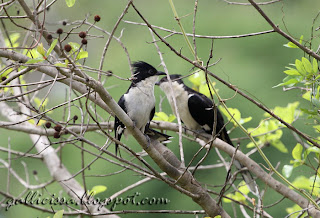
Next morning we set off for birding near the archaeological site and were joined by a few keen students from the Rajarata University. Here first to greet us was our national bird, the Sri Lanka Jungle fowl, while the sharp eyes of Indrika spotted a Changeable Hawk-eagle which we observed with the scope for quite a while. The time between breakfast and lunch was spent listening to lectures by Professor Kotagama which was very interesting for all of us as we learnt many things we didn’t know about birds. After lunch it was decided to go birding near the lake just outside the university. The highlight of this expedition was a Brown Fish-owl, while quite a number of aquatic birds including Cormorants, White-breasted Waterhen, Purple Swamphen and a pair of Woolly-necked Storks were also observed. 
The next morning we were up early as we had planned a day birding trip to Kebithigollewa and Padaviya. The university students also joined us for this expedition. Our guide for this leg of the journey was a FOGSL member from Kebithigollewa named Harsha. We were taken to two birding hotspots on the way to Padawiya wewa. The first was a lake where we were able to observe some spoonbills, Gull-billed Terns and a Wood Sandpiper. The second path also led to a lake but it was completely dry as it was the dry season. We were able to view a pair of Pied Cuckoos and also a Black Drongo. Lunch was at Padawiya wewa where most of the members had a refreshing bath in the wewa. On the way back an unexpected stop was made at a lake at the edge of the road which proved to be a very good birding area. By the end of this stop we were all quite tired and couldn’t wait to go back to the guesthouse for some hot tea and a shower. 
Next morning we headed to Ritigala. On the way we stopped at two lakes of which the second lake was very good for birding. The sharp eyes of Professor Kotagama spotted Lesser Sand Plovers, Wood Sandpipers and also a lone Little Ringed Plover. After we reached Ritigala we were given a briefing about the archaeological site by one of the lecturers from the Rajarata University. We walked up to the designated point while viewing the ruins. It was a shame to see many groups of people acting in a manner which was not suitable within an area which is legally protected for safeguarding its rich heritage for future generations. It was around 12 noon when we said our final goodbyes to our friends from the Rajarata University. It was a trip where we made new friends and managed to observe 118 bird species!

Participants
Mr. Ranjith Silva, Miss. Uraji Karunaratne, Mr. Asitha Samarawickrama, Miss. W.A. Harsha Abewickrama, Ms. Sindy de Silva, Mrs. Tharidra de Silva, Kids Rahul and Shahal, Mr. Amila Salgado, Mr. Rohan Kaththiriarachchi, Ms. Shamila Perera , Mr. Indrika Pradeepa, Prof. S.W. Kotagama
Reported by Asitha Samarawikram
Bird List by Indrika Pradeepa
Photos by Amila Salgado (read his report here)
See more photos here.
Bird List
Sri Lanka Junglefowl
Indian Peafowl
Lesser Whistling-duck
Cotton Pygmy-goose
Painted Stork
Asian Openbill
Woolly-necked Stork
Black-headed Ibis
Black-crowned Night-heron
Indian Pond-heron
Cattle Egret
Grey Heron
Purple Heron
Great Egret
Intermediate Egret
Little Egret
Spot-billed Pelican
Little Cormorant
Indian Cormorant
Great Cormorant
Oriental Darter
Oriental Honey-buzzard
Brahminy Kite
White-bellied Sea-eagle
Crested Serpent-eagle
Shikra
Black Eagle
Changeable Hawk-eagle
White-breasted Waterhen
Purple Swamphen
Black-winged Stilt
Red-wattled Lapwing
Lesser Sand Plover
Pheasant-tailed Jacana
Wood Sandpiper
Common Sandpiper
Gull-billed Tern
Whiskered Tern
Spotted Dove
Emerald Dove
Orange-breasted Green-pigeon
Pompadour Green-pigeon
Green Imperial-pigeon
Alexandrine Parakeet
Rose-ringed Parakeet
Pied Cuckoo
Asian Koel
Blue-faced Malkoha
Greater Coucal
Brown Fish-owl
Jerdon's Nightjar
Indian Nightjar
Asian Palm-swift
Little Swift
Crested Treeswift
Indian Roller
Stork-billed Kingfisher
White-throated Kingfisher
Common Kingfisher
Pied Kingfisher
Little Green Bee-eater
Sri Lanka Grey Hornbill
Malabar Pied Hornbill
Brown-headed Barbet
Crimson-fronted Barbet
Coppersmith Barbet
Black-rumped Flameback
Greater Flameback
Ashy Woodswallow
Common Iora
Common Woodshrike
Large Cuckooshrike
Black-headed Cuckooshrike
Small Minivet
Bar-winged Flycatcher-shrike
Black-hooded Oriole
Black Drongo
White-bellied Drongo
Asian Paradise-flycatcher
House Crow
Jungle Crow
Barn Swallow
Red-rumped Swallow
Jerdon's Bushlark
Ashy-crowned Sparrow-lark
Zitting Cisticola
Grey-breasted Prinia
Jungle Prinia
Ashy Prinia
Plain Prinia
Black-crested Bulbul
Red-vented Bulbul
White-browed Bulbul
Yellow-browed Bulbul
Common Tailorbird
Brown-capped Babbler
Tawny-bellied Babbler
Dark-fronted Babbler
Yellow-eyed Babbler
Yellow-billed Babbler
Oriental White-eye
Common Myna
Oriental Magpie-robin
White-rumped Shama
Indian Robin
Tickell's Blue-flycatcher
Jerdon's Leafbird
Golden-fronted Leafbird
Thick-billed Flowerpecker
Pale-billed Flowerpecker
Purple-rumped Sunbird
Purple Sunbird
Long-billed Sunbird
House Sparrow
Baya Weaver
White-rumped Munia
Scaly-breasted Munia
Paddyfield Pipit
Subscribe to:
Posts (Atom)