
The Field Ornithology Group of Sri Lanka’s (FOGSL) field trip to Mihintale and Ritigala took place from the 21-24th of August 2010 with the participation of 13 FOGSL members headed by Professor Sarath Kotagama. Our base was the guest house of the Rajarata University which was in very close proximity to the Mihintale archaeological site. On arrival at the guesthouse we were greeted by three Sri Lanka Grey Hornbills and by following them we managed to see two Golden-fronted Leafbirds and a pair of Indian Brown Mongoose. 
After lunch and a little rest we set off on a birding walk through the gardens of the university and was amazed by the variety of birds that called the university their “home”. We were very lucky to see a whole family of Malabar Pied Hornbills consisting of a father, mother and a daughter!! Some of us were also able to witness a Crested Serpent-eagle being hawked by a Shikra. Other birds seen included Orange-breasted and Pompadour Green-pigeons, Yellow-eyed and Tawny-bellied Babblers and also Ashy, Plain and Jungle Prinias. Huge rain clouds were the only thing that stopped us from more birding and we had to retreat to the guesthouse to avoid getting wet. After dinner we could not resist going out to search for a Jerdon’s Nightjar which was heard very close to the guesthouse. Our efforts were rewarded when we spotted it on a branch of a tree a few meters away from the path. 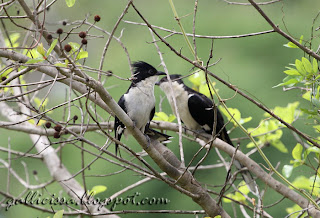
Next morning we set off for birding near the archaeological site and were joined by a few keen students from the Rajarata University. Here first to greet us was our national bird, the Sri Lanka Jungle fowl, while the sharp eyes of Indrika spotted a Changeable Hawk-eagle which we observed with the scope for quite a while. The time between breakfast and lunch was spent listening to lectures by Professor Kotagama which was very interesting for all of us as we learnt many things we didn’t know about birds. After lunch it was decided to go birding near the lake just outside the university. The highlight of this expedition was a Brown Fish-owl, while quite a number of aquatic birds including Cormorants, White-breasted Waterhen, Purple Swamphen and a pair of Woolly-necked Storks were also observed. 
The next morning we were up early as we had planned a day birding trip to Kebithigollewa and Padaviya. The university students also joined us for this expedition. Our guide for this leg of the journey was a FOGSL member from Kebithigollewa named Harsha. We were taken to two birding hotspots on the way to Padawiya wewa. The first was a lake where we were able to observe some spoonbills, Gull-billed Terns and a Wood Sandpiper. The second path also led to a lake but it was completely dry as it was the dry season. We were able to view a pair of Pied Cuckoos and also a Black Drongo. Lunch was at Padawiya wewa where most of the members had a refreshing bath in the wewa. On the way back an unexpected stop was made at a lake at the edge of the road which proved to be a very good birding area. By the end of this stop we were all quite tired and couldn’t wait to go back to the guesthouse for some hot tea and a shower. 
Next morning we headed to Ritigala. On the way we stopped at two lakes of which the second lake was very good for birding. The sharp eyes of Professor Kotagama spotted Lesser Sand Plovers, Wood Sandpipers and also a lone Little Ringed Plover. After we reached Ritigala we were given a briefing about the archaeological site by one of the lecturers from the Rajarata University. We walked up to the designated point while viewing the ruins. It was a shame to see many groups of people acting in a manner which was not suitable within an area which is legally protected for safeguarding its rich heritage for future generations. It was around 12 noon when we said our final goodbyes to our friends from the Rajarata University. It was a trip where we made new friends and managed to observe 118 bird species!

Participants
Mr. Ranjith Silva, Miss. Uraji Karunaratne, Mr. Asitha Samarawickrama, Miss. W.A. Harsha Abewickrama, Ms. Sindy de Silva, Mrs. Tharidra de Silva, Kids Rahul and Shahal, Mr. Amila Salgado, Mr. Rohan Kaththiriarachchi, Ms. Shamila Perera , Mr. Indrika Pradeepa, Prof. S.W. Kotagama
Reported by Asitha Samarawikram
Bird List by Indrika Pradeepa
Photos by Amila Salgado (read his report here)
See more photos here.
Bird List
Sri Lanka Junglefowl
Indian Peafowl
Lesser Whistling-duck
Cotton Pygmy-goose
Painted Stork
Asian Openbill
Woolly-necked Stork
Black-headed Ibis
Black-crowned Night-heron
Indian Pond-heron
Cattle Egret
Grey Heron
Purple Heron
Great Egret
Intermediate Egret
Little Egret
Spot-billed Pelican
Little Cormorant
Indian Cormorant
Great Cormorant
Oriental Darter
Oriental Honey-buzzard
Brahminy Kite
White-bellied Sea-eagle
Crested Serpent-eagle
Shikra
Black Eagle
Changeable Hawk-eagle
White-breasted Waterhen
Purple Swamphen
Black-winged Stilt
Red-wattled Lapwing
Lesser Sand Plover
Pheasant-tailed Jacana
Wood Sandpiper
Common Sandpiper
Gull-billed Tern
Whiskered Tern
Spotted Dove
Emerald Dove
Orange-breasted Green-pigeon
Pompadour Green-pigeon
Green Imperial-pigeon
Alexandrine Parakeet
Rose-ringed Parakeet
Pied Cuckoo
Asian Koel
Blue-faced Malkoha
Greater Coucal
Brown Fish-owl
Jerdon's Nightjar
Indian Nightjar
Asian Palm-swift
Little Swift
Crested Treeswift
Indian Roller
Stork-billed Kingfisher
White-throated Kingfisher
Common Kingfisher
Pied Kingfisher
Little Green Bee-eater
Sri Lanka Grey Hornbill
Malabar Pied Hornbill
Brown-headed Barbet
Crimson-fronted Barbet
Coppersmith Barbet
Black-rumped Flameback
Greater Flameback
Ashy Woodswallow
Common Iora
Common Woodshrike
Large Cuckooshrike
Black-headed Cuckooshrike
Small Minivet
Bar-winged Flycatcher-shrike
Black-hooded Oriole
Black Drongo
White-bellied Drongo
Asian Paradise-flycatcher
House Crow
Jungle Crow
Barn Swallow
Red-rumped Swallow
Jerdon's Bushlark
Ashy-crowned Sparrow-lark
Zitting Cisticola
Grey-breasted Prinia
Jungle Prinia
Ashy Prinia
Plain Prinia
Black-crested Bulbul
Red-vented Bulbul
White-browed Bulbul
Yellow-browed Bulbul
Common Tailorbird
Brown-capped Babbler
Tawny-bellied Babbler
Dark-fronted Babbler
Yellow-eyed Babbler
Yellow-billed Babbler
Oriental White-eye
Common Myna
Oriental Magpie-robin
White-rumped Shama
Indian Robin
Tickell's Blue-flycatcher
Jerdon's Leafbird
Golden-fronted Leafbird
Thick-billed Flowerpecker
Pale-billed Flowerpecker
Purple-rumped Sunbird
Purple Sunbird
Long-billed Sunbird
House Sparrow
Baya Weaver
White-rumped Munia
Scaly-breasted Munia
Paddyfield Pipit


