Showing posts with label Peak Wilderness. Show all posts

Monday, November 8, 2010

FOGSL Field Trip to Peak Wilderness

On a warm, sunny day, on 22nd October, peaceful and calm Eratne lay before us, twelve members comprising veterans and novices of FOGSL who were to enjoy two days in Peak Wilderness. Adawikanda was our last stop before the long climb to our abode; Seetha Gangula nawathanpola began by foot.


Peak Wilderness nestles in the centre of the Western ridge of the Central Highlands, north-east of Ratnapura. The wilderness also stretches towards the borders between Central and Sabaragamuwa provinces. With the abundance of treasures and mysteries, Peak Wilderness has been classified as the most constantly wet part of Asia, West of Borneo.


Our slow and tedious walk lasted for about 4 1/2 hours. In spite of the fatigue, we were in awe of the surroundings. We had lunch near a site where a dam was built, to make use of waters of a cascading waterfall to generate electricity to the villagers as well as the national grid. Cool winds and water, replenished us for awhile. Back on the route, we increased our pace, knowing we had to reach our destination before nightfall.


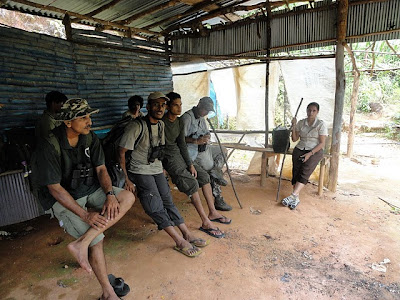
The valley spread before us, as we climbed higher. Through trees and shrubs we could get a peek at the vast expanse of greenery beyond. After walking, stumbling and panting along the distance, we spotted the Ambalama with relief. The waters of Seethagangula beckoned us quietly. Tents were put up, by the able men while Mahatun Mama, a faithful guide and friend of members of FOG for the past 5 years, along with his aides, Bandara and another, got the hearth going for the preparation of tea and dinner.

The only females in the herd, Komila and I hurried to the river to take a wash before it grew too dark. While we attempted to hide behind a rock for privacy, we later heard that a troupe of monkeys had apparently been watching us from a tree!


Morning dawned on the 23rd, after a terribly cold night. The few Buddhists in the group were hoping to climb Shri Pada. After much thought, I decided to join the 7 members to climb the rock. We began the long journey around 6.00 a.m. Four members stayed back to go birding in the surroundings adjacent to the Ambalama.


Legs aching, panting madly, slipping and struggling we trekked for about 1 1/2 hours before stopping over for a breakfast of ‘Kadala’ and coconut at a dilapidated ambalama, which during the season, would have been thriving with free meals and hot cups of tea for pilgrims.

The long trek began again with us being determined to spot a few birds to add to the list! It was treat, therefore, to see a Legg’s flower pecker having its own breakfast, feeding on some small fruit. A pair of Nuthatches was making a racket on a tree, presumably pecking away at some insects they had scented and spotted. We saw yellow eared bulbuls, hill mynahs and red vented bulbuls chirping away, on that glorious morning. The air was fresh and pure, and the sun shone bright and hot on us.


“Start climbing early, try to make it to the summit before 1.00 p.m. If you can’t and even if the summit is just there to reach, you need to climb down looking at it, by 1.30 p.m and reach the ambalama by 6.00 p.m.” were the instructions we got from Dr. Newton Jayawardane and Chaminda Jayaratne. We knew we had to keep to the deadlines and we were chasing time! There were traces of Elephant dung as we passed ‘batakelle’. A few blood thirsty leeches were making an effort to get on us, and some succeeded in making us bleed a fraction.


We reached the summit around 12.45 p.m. and the experience was awesome! Below, the montane forest cover spread. Vast, pure untouched and spellbinding, the canopy was an umbrella amidst the clouds. We could see the Blue waters of Castlereigh and Mousakelle Reservoirs, and of course the winding path we took was also visible, making us aware of the long trek back on the same route. It was hot and sunny up there. The winds fanned us. After prayers, and a steaming cup of tea given to us by the security officers at the summit, we began our descend. It was disheartening to see volumes of polythene carelessly strewn down the slopes of the summit. Pollution, a burning matter of concern where ever we happened to go, was not strange even to Peak Wilderness. We collected as much garbage as we could, and burnt them all at Galwangediye Kade Ambalama.

Descending was tedious as climbing was. After lunch at Ahala Kanuwa Ambalama, we began a steady descend making sure to pass Batakelle, before 3.30 p.m. We had to avoid elephants incase we ran into them! A prayer to see the Dollar bird was not answered. However, there were species of yellow eared, and black capped bull bulls which greeted us on the way down. Mahatun Mama, bare footed, chirpy and agile, guided us through out this tedious and exhilarating journey.


We reached our Ambalama by 6.05 p.m., much to our delight and probably to the relief of the others who would have been waiting for us. After the check list was done, and dinner taken, we retired to our respective tents, to get whatever sleep we could before returning to base, Adawikanda the next morning. Back at Adawikanda the following afternoon, everyone waited to have a dip in the river. Bandara welcomed us to his humble home, to give us a delicious meal for lunch. We relished the waldel kos ata curry, a novelty and a rare meal for city dwellers.


A few of us had to bid farewell to the group at Avissawella because we were Kandy bound. Back at home; to reminisce and re-live moments, it was a journey worth, making the effort of going! An important learning outcome was, to stay fit and healthy. Life becomes easier when one is in good health!


Bird List

Sri Lanka Jungle fowl
Great Tit
Sri Lanka yellow fronted barbet
Black Crested Bulbull
SriLanka grey hornbill
Red Vented Bulbul
White throated Kingfisher
SriLanka Yellow eared bulbul
Blue tailed bee-eater
Black bulbul
Sri Lanka Hanging Parrot
Yellow browed bulbul
Indian Swiftlet
Sri Lanka White eye
Spotted Dove
Oriental White eye
Emerald Dove
Greenish Warbler
Green Imperial Pigeon
Large billed leaf warbler
Crested Serpent Eagle
SriLanka Brown capped Babbler
Shikra
SriLanka Schimiter Babbler
Brown Shrike
Dark Fronted Babbler
Sri Lanka Blue Magpie
Sri Lanka Orange Billed Babbler
Black Hooded Oriole
Yellow Billed Babbler
Scarlet Minivet
Thick Billed Flower Pecker
Bar winged Flycatcher shrike
Sri lanka Legge’s Flower Pecker
White bellied Drongo
Pale Billed Flower pecker
Crested Drongo
Purple rumped sunbird
Black Naped Monarch
Grey Wagtail
Asian Paradise Flycatcher
White Rumped Munia
Common Iora
Sri Lanka Spot winged Thrush
Asian Brown Flycatcher
Brown breasted flycatcher
Sri Lanka Dull Blue Flycatcher
Tickell’s Blue Flycatcher
Grey Headed Canary Flycatcher
Sri Lanka Myna
Hill Myna
Velvet Fronted Nuthatch


List of Participants:

Mr. Chaminda Jayaratne, Dr. Newton Jaywardena, Ms. Sulakmi Weragama, Mr. Rohan Kaththiriarachchi, Ms. Komila Stanislaus, Mr. Ruwan, Mr. Ranjith Fernando, Mr. Chana, Mr. Nashad Hafi, Mr. Faris, Mr. Amudhesh

Bird list and Report: Sulekshmi Weragama
Photos: Sulekshmi Weragama, Rohan Kaththiriarachchi and Chaminda Jayaratne

To see more Photos

Friday, June 27, 2008

Birding at Adam's Peak

FOGSL organised another successful field visit for its members from 20th to 22nd June. Trekking along the foot path from Palabaddala was memorable experience to the members. Following report on the visit was provided by Dr. Newton Jayawardane.

We left the FOGSL office (at University of Colombo) around 7.30 am on Friday the 20th of June. As there were three last minute drop outs there were ample amount of seats left in our coach! We stopped at Meenhanna, Getaheththa at the 66th Km post for breakfast. The manager of the hotel welcomed us with his much obliging smile. We all enjoyed his buffet breakfast very much!
We arrived at Palabaddala temple by noon. ‘Bana Maduwa’ was our base camp. We erected four tents inside it. This was very helpful for us to escape from mosquitoes. Ratnapura district was subject to a ‘chicken guinea’ epidemic few weeks ago. Further we were protected from the much chilly cold weather which prevails there at nights. In the afternoon we did birding around and went to see the 'Mapolana Ella'. This is the highest water fall of the Rathnapura district and fourth highest water fall of Sri Lanka. We were much greeted by the calls of the Sri Lanka Myna and Sri Lanka Layards Parakeets. We experienced much rain on our way back but had the greetings of lots of black bulbuls. We saw ratkeliya (endemic), patkela (endemic), bovitiya and sapu plants with fruits. Dilini who joined us from the Botany department was a great help for us to identify plant species. After the dinner we prepared the bird list and had a lengthy discussion about the following day birding and climb to the Adams peak. Those who participate on earlier trips to peak wilderness discussed the problems encountered, possible causes for them and how we tackled them. Basic body physiology and Medical aspect of climbing was dealt by a Doctor in the team. Our team leader Mr Nashath Hafi gave clear instructions to stop climbing and to turn back by 2.00 pm. It was a very wise decision he took and we saw the results on the following day!!
We had a good night sleep inside the tents but sleep was disturbed occasionally due to snoring of our own comrades!
Day 2

Sunday morning we woke up early. Three hill swallows were on the electric wire just ahead of our door. We packed our breakfast and lunch packets and started our journey by 7.00 am. We saw all six varieties of Bulbuls on the way. We came across a bird flock and Crested Drongos, a pair of Trogons and Lesser yellow-naped Woodpecker were clearly seen.

Sri Lanka army was constructing cemented steps and completed 3800 steps by now. Having climbed all steps we came to ‘Geththam pana’, a place for the nature lovers with a panorama. The water stream there was fascinating. We started moving further up and unfortunately had to face torrential rains. By 1.30 pm we had come close to Seetha gangula. We concluded it was impossible to go to peak and decided to turn back. It was sad but we had to obey the instructions of our team leader. On the way we had a good break and our lunch at ‘Geththam pana’ and started to descend. Three dogs were accompanying us from Palabaddala, later they became a nuisance and started barking and quarrelling on the way. They disturbed the birds including a group of Blue magpies. So even you are a dog lover do not take them on birding trips. We saw a large number of White-bellied Drongos, Sri Lanka Mynas and Black Bulbuls. We reached the base camp by 5.30 pm. On the way back, we saw Pelang (endemic) and Goraka trees with fruits. We did not forget to try on some goraka fruits. Some of us enjoyed a bath at an adjoining "Peella". Unlike earlier peak wilderness trips all members were fit and healthy this time after climbing!! As usual after a tasty dinner, we had our discussions and bird list prepared. The meals we had were typical village meals and were much tasty. Some of us ate 'Thebu mallum, Alakola maluwa and Aligatapera kola malluma' for the first time of our life!!
Day 3
Quite interesting. As soon as we started birding, we saw a White-faced Starling and a group of Imperial Green Pigeons. Amila's knowledge and his telescope was an immense help for us. We explored the jungle called 'Akkara panaha' that located close to the Mapalana waterfall. In addition to our usual birding we saw the following trees; kekiriwara, hora, galweralu, kirihembiliya, freycinetia, keena & walukeena (all are enemics) and wal kopi. We returned to our base camp by 11.30am. After lunch we left for Colombo and reached the University by 5.30pm.
Participants: Nishanthi Perera, Kusum Fernando, Chameera Senavirathne, Garlinga Herath, Pushpakumara, N.R. Dilani, Devi Jayathilaka, C.R.I. Gomez, Newton Jayawardhana, L.W. Manawadu, K.Y. Ganeshapraya, Mohamad Faris, Amila Salgadu, A. Nashath B. Hafi, Indrika Pradeepa

The list of birds recorded during the three day visit.

Sri Lanka Spurfowl
Sri Lanka Junglefowl
Oriental Honey-buzzard
Crested Serpent-eagle
Shikra
Black Eagle
White-breasted Waterhen
Rock Pigeon
Sri Lanka Wood-pigeon
Spotted Dove
Emerald Dove
Pompadour Green-pigeon
Green Imperial-pigeon
Sri Lanka Hanging-parrot
Plum-headed Parakeet
Sri Lanka Emerald-collared Parakeet
Greater Coucal
Indian Swiftlet
Asian Palm-swift
Little Swift
Malabar Trogon
White-throated Kingfisher
Sri Lanka Grey Hornbill
Brown-headed Barbet
Sri Lanka Yellow-fronted Barbet
Crimson-fronted Barbet
Lesser Yellownape
Black-rumped Flameback
Greater Flameback
Common Iora
Black-headed Cuckooshrike
Small Minivet
Scarlet Minivet
Bar-winged Flycatcher-shrike
Black-hooded Oriole
White-bellied Drongo
Greater Racket-tailed Drongo
Black-naped Monarch
Asian Paradise-flycatcher
Sri Lanka Magpie
Jungle Crow
Great Tit
Hill Swallow
Red-rumped Swallow
Black-crested Bulbul
Red-vented Bulbul
Sri Lanka Yellow-eared Bulbul
Common name
White-browed Bulbul
Yellow-browed Bulbul
Asian Black Bulbul
Common Tailorbird
Sri Lanka Brown-capped Babbler
Sri Lanka Scimitar-babbler
Tawny-bellied Babbler
Dark-fronted Babbler
Sri Lanka Orange-billed Babbler
Yellow-billed Babbler
Sri Lanka Ashy-headed Laughingthrush
Sri Lanka White-eye
Oriental White-eye
Velvet-fronted Nuthatch
Sri Lanka Myna
Hill Myna
Common Myna
Sri Lanka White-faced Starling
Sri Lanka Spot-winged Thrush
Sri Lanka Scaly Thrush
Oriental Magpie-robin
Sri Lanka Dull-blue Flycatcher
Tickell's Blue-flycatcher
Grey-headed Canary-flycatcher
Jerdon’s Leafbird
Golden-fronted Leafbird
Sri Lanka White-throated Flowerpecker
Pale-billed Flowerpecker
Long-billed Sunbird
House Sparrow
White-rumped Munia
Black-throated Munia


Photos: Indrika Pradeepa